

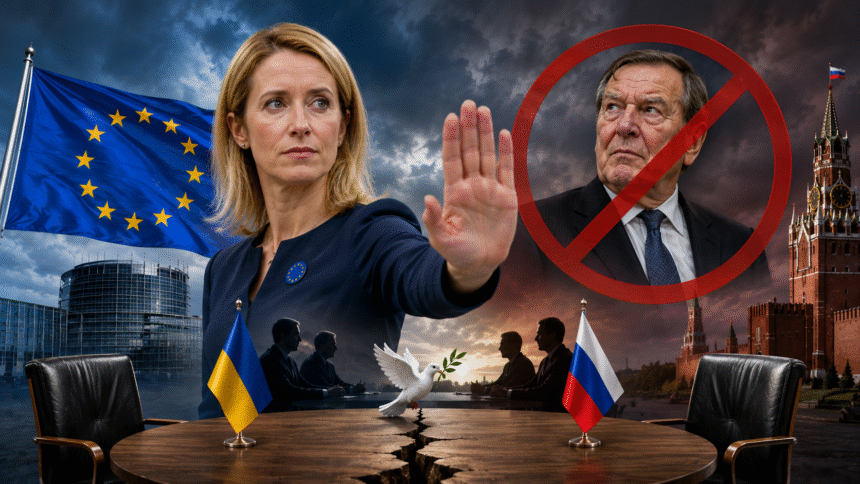
European Union foreign policy chief Kaja Kallas has rejected the idea of appointing former German Chancellor Gerhard Schröder as a mediator in possible Ukraine-Russia talks, saying his long-standing ties to Moscow make him unsuitable for a neutral diplomatic role.
The proposal was reportedly raised by Russian President Vladimir Putin, who suggested that Schröder could serve as a European interlocutor in future discussions. But the idea was quickly dismissed in Brussels, where EU officials argued that Moscow should not be allowed to choose who represents Europe in any potential peace process.
Kallas said it would not be wise to let Russia appoint a negotiator on Europe’s behalf. She also pointed to Schröder’s past roles with Russian state-linked energy companies, arguing that this history creates a clear conflict of interest. According to Euronews, Kallas said Schröder would effectively be “sitting on both sides of the table.”
Schröder has remained controversial in Europe because of his close relationship with Putin and his involvement in Russian energy projects after leaving office. He served on the board of Russian oil giant Rosneft until 2022 and was also connected to Nord Stream and other Russian energy interests.
Ukraine also rejected the proposal. Ukrainian Foreign Minister Andrii Sybiha said Kyiv did not support Schröder as a mediator, reinforcing Ukraine’s position that any negotiation process must involve figures trusted by Ukraine and its European partners.
The dispute reflects a deeper concern inside the European Union: that Russia may be trying to shape the diplomatic process in its own favor before any serious talks begin. For Brussels, accepting a mediator preferred by Moscow would weaken Europe’s credibility and raise doubts about the fairness of future negotiations.
The rejection also comes at a sensitive moment in the war. Russia has signaled openness to talks, but European officials remain skeptical of Moscow’s intentions, especially as fighting and attacks continue. Kallas and other EU ministers have stressed that any peace process must protect Ukraine’s sovereignty and cannot be built around Russian political preferences.
For the EU, the message is clear: Europe will not allow Moscow to choose its representatives or influence the terms of mediation. Any future talks on Ukraine must include credible, impartial figures and must respect Kyiv’s role as the country directly affected by the war.
Kallas’s rejection of Schröder therefore goes beyond one name. It signals the EU’s determination to maintain political control over its own position, avoid Russian influence in the negotiation process, and ensure that any path toward peace does not come at Ukraine’s expense.