

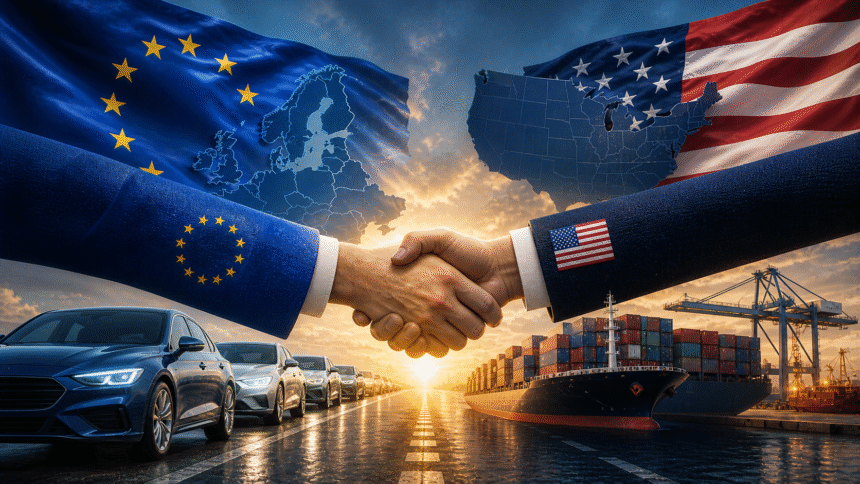
European Union countries are pushing to finalize a trade settlement with the United States in an effort to prevent a new escalation over car tariffs. The move comes after U.S. President Donald Trump threatened to raise tariffs on European cars and trucks to 25%, accusing the EU of failing to fully implement a previous trade agreement with Washington.
The dispute centers on a deal reached in 2025, which set tariffs on most European goods at 15% and required the EU to move forward with lower duties on certain U.S. industrial goods. Washington argues that the United States has acted on its side of the agreement, while the EU’s implementation has been slowed by internal political negotiations and demands for safeguards from the European Parliament.
For Europe, the stakes are high. A rise in U.S. auto tariffs would place serious pressure on the continent’s car industry, especially in Germany, France, and Italy, where vehicle manufacturing remains a major source of jobs, exports, and industrial strength. German automakers are particularly exposed because the United States is one of their most important export markets.
Germany has warned that the impact could be significant. Shares in major German carmakers, including Porsche, BMW, Mercedes-Benz, and Volkswagen, fell after Trump’s tariff threat, reflecting investor concern over higher costs and weaker competitiveness in the American market. Analysts warned that the new tariffs could cost German automakers billions in operating profit.
EU governments are therefore trying to accelerate negotiations before the dispute turns into a wider trade confrontation. Most member states support a fast settlement, but the European Parliament wants to include safeguards before approving the necessary legislation. That has created a delicate balance: Brussels wants to avoid provoking Washington, but it also does not want to appear as if it is surrendering to pressure.
French Finance Minister Roland Lescure said the EU should look beyond the political noise and continue the process in good faith. His comments reflected the position of several European governments that want to preserve the trade deal and avoid a damaging cycle of tariffs and retaliation.
The auto sector is especially vulnerable because it is already facing several challenges at once. European manufacturers are dealing with weak demand in some markets, the costly transition to electric vehicles, stronger competition from Chinese carmakers, and rising production costs. A new U.S. tariff increase would add another burden at a difficult moment.
The dispute also has broader political meaning. Trade tensions between Washington and Brussels are rising at the same time as Europe is dealing with security uncertainty, the war in Ukraine, and pressure to reduce dependence on the United States. A tariff battle would make transatlantic relations even more fragile.
For the United States, higher tariffs are presented as a way to pressure Europe into honoring the agreement and protecting American industry. For the EU, however, the threat is seen as a risky escalation that could damage both economies and weaken cooperation at a time when the West is already facing major geopolitical challenges.
In the end, the EU’s goal is clear: avoid a trade war, protect its auto industry, and keep the U.S.-Europe economic relationship from deteriorating further. But the coming negotiations will test whether Brussels can satisfy Washington without creating a political backlash inside Europe.