


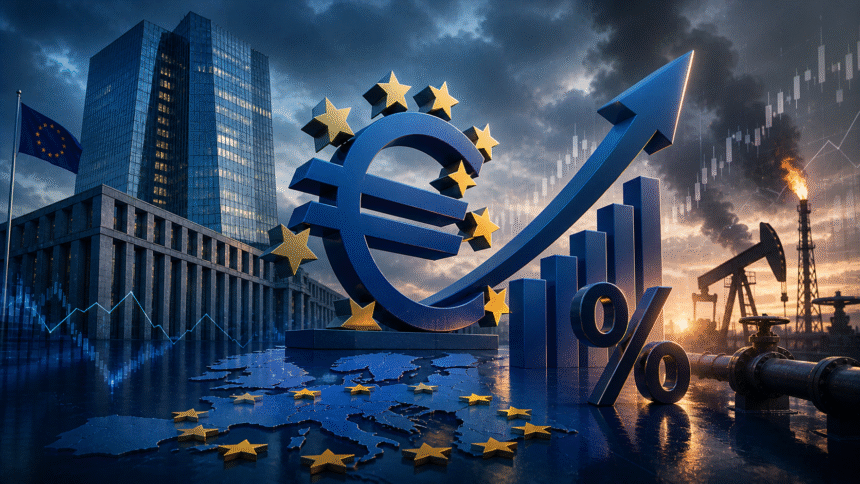
The European Central Bank is moving closer to raising interest rates in June, as policymakers grow increasingly worried that higher energy prices and persistent inflation could spread through the eurozone economy.
Slovak central bank governor and ECB policymaker Peter Kazimir said a June rate hike is now “all but inevitable,” warning that rising energy costs linked to the war in the Middle East are beginning to feed into broader prices. His comments suggest that the ECB may soon shift from caution to action after keeping rates unchanged at its latest meeting.
The ECB’s concern is not only the immediate rise in energy prices. Policymakers fear that expensive fuel, electricity, and transport could push up costs for businesses, which may then pass those costs on to consumers. If wages and price expectations also rise, temporary inflation could become more permanent.
The eurozone is especially exposed to energy shocks because it imports a large share of its energy needs. Any disruption linked to the Middle East, including pressure on oil and gas routes, can quickly affect factories, transport companies, households, and food prices. The ECB’s own bulletin projects that inflation could rise sharply to 3.1% in the second quarter of 2026, driven mainly by the energy surge caused by the war.
The debate inside the ECB is still not fully settled. French central bank governor François Villeroy de Galhau said the bank needs a “critical mass of data” before raising rates, including clearer evidence that inflation is becoming embedded through wages, underlying prices, and consumer expectations. His comments reflect the more cautious side of the ECB, which fears that raising rates too quickly could damage weak economic growth.
Markets, however, are increasingly preparing for tighter monetary policy. Reuters reported that ECB policymakers are likely to raise rates at least twice, starting at the next meeting in June, unless energy prices fall quickly and the situation in the Middle East improves.
For European households, a rate hike would mean borrowing could become more expensive. Mortgages, business loans, and consumer credit may face renewed pressure. For companies, especially in energy-intensive sectors such as manufacturing, chemicals, transport, and food production, higher rates would add another burden at a time when input costs are already rising.
But from the ECB’s perspective, the greater danger is losing control of inflation expectations. If people and businesses start to believe that prices will keep rising, they may adjust wages, contracts, and pricing decisions accordingly. That could make inflation harder to bring back down to the ECB’s 2% target.
The decision expected in June will therefore be a difficult one. The ECB must balance two risks: raising rates too soon and weakening growth, or waiting too long and allowing inflation to become more persistent.
In the end, the message from Frankfurt is clear: the Middle East energy shock has changed the eurozone’s economic outlook. If inflation continues to spread beyond energy prices, the ECB is likely to respond with higher interest rates — even if Europe’s economy is already under pressure.