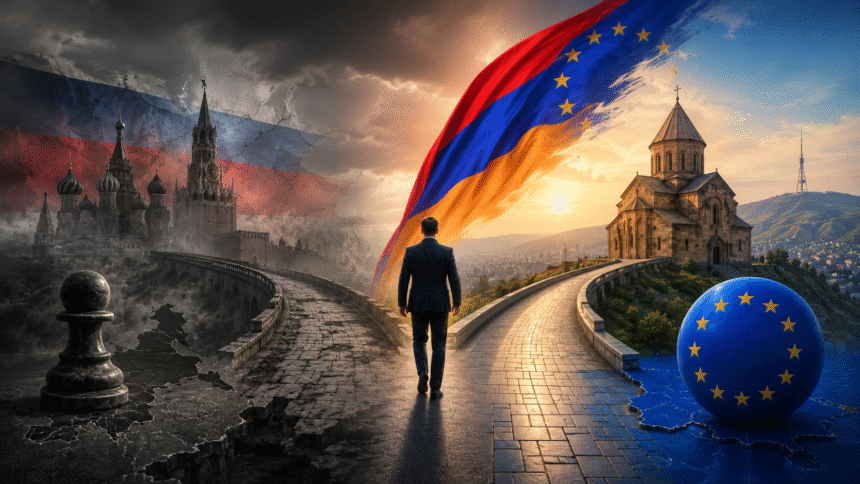
Armenia is continuing its gradual political shift away from Russia and toward closer relations with Europe following a new electoral victory for the party of Prime Minister Nikol Pashinyan, a leader who has increasingly promoted stronger ties with the European Union and Western institutions.
The latest election results were widely viewed as a public endorsement of Yerevan’s pro-European direction, strengthening the Armenian government’s position at a time of growing tensions with Moscow. Analysts say the outcome reflects rising frustration Armenia over Russia’s role in regional security issues and Moscow’s declining influence in the South Caucasus.
Prime Minister Pashinyan has repeatedly emphasized the need for Armenia to diversify its international partnerships and reduce its dependence on Russia politically, economically, and militarily. Over the past two years, Yerevan has expanded cooperation with European countries in areas including trade, democratic reforms, border monitoring, and security coordination.
The Armenian leadership has also deepened dialogue with the European Union regarding economic integration and institutional reforms, while European officials continue to express support for Armenia’s democratic transition and regional stability efforts.
However, Armenia’s shift toward Europe has sharply increased tensions with Moscow. Russian officials warned that continued movement away from traditional alliances could lead to serious economic and political consequences for Yerevan. Moscow remains Armenia’s largest economic partner in several sectors and still maintains a military presence in the country.
Russian media and officials have accused the Armenian government of weakening historical ties and undermining regional security arrangements that were established after the collapse of the Soviet Union. In response, Armenian officials argue that the country must pursue a more balanced foreign policy that better serves its national interests and sovereignty.
The political shift comes amid broader geopolitical competition in the region, where Western powers are seeking to expand their influence while Russia faces mounting pressure due to the ongoing war in Ukraine and strained relations with Europe.
European leaders welcomed the election outcome and reaffirmed their support for Armenia’s reform agenda. Several European governments are expected to increase financial assistance and cooperation programs with Yerevan in the coming months.
Despite the growing momentum toward Europe, Armenia still faces major economic and security challenges that make a complete break with Russia unlikely in the near future. Nevertheless, the latest developments signal a significant transformation in Armenian foreign policy and a potential long-term realignment in the South Caucasus region.