


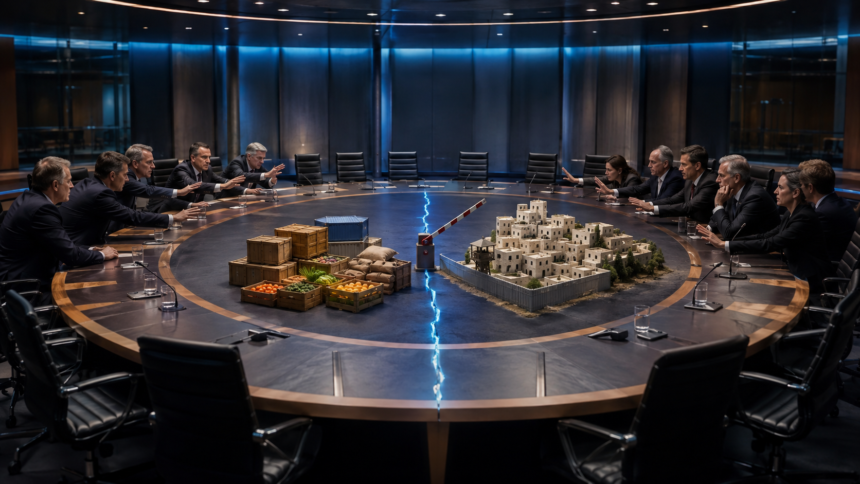
European Union foreign ministers have failed to reach a unified position on proposed trade restrictions targeting Israeli settlements in the occupied West Bank, exposing persistent divisions among the bloc’s 27 member states over how to respond to settlement expansion and rising violence.
The issue was discussed during an informal meeting of EU foreign ministers in Wicklow, Ireland. Several governments called for collective European action, arguing that commercial relations with the settlements undermine international law and the prospects of establishing an independent Palestinian state.
Among the measures under consideration is a ban on imports originating from Israeli settlements. Alternative proposals include imposing prohibitive tariffs or introducing a licensing system that would place tighter controls on settlement products entering the European market.
Supporters of stronger action argue that restrictions should distinguish between trade conducted within Israel’s internationally recognized borders and commercial activity connected to settlements in occupied territory. Ireland, Spain and several other European countries have pushed for a firmer response, while some member states remain reluctant to endorse sanctions or measures that could damage relations with Israel.
The European Commission has outlined possible options, but implementing significant restrictions would require sufficient political and legal support from EU governments. Decisions involving foreign policy sanctions generally require unanimity, allowing any member state to block collective action.
EU foreign policy chief Kaja Kallas previously said that a ban on settlement trade had attracted stronger support than other possible measures. However, the bloc remains unable to convert that backing into an agreed policy, and diplomats have been tasked with continuing technical discussions.
The debate has intensified amid concern over settlement construction and violence involving Israeli settlers and Palestinian communities. European governments have also criticized plans to advance construction in the E1 area, warning that the project could divide the West Bank and further undermine the territorial continuity of a future Palestinian state.
Israeli authorities reject accusations that their settlement policies prevent peace and oppose measures that single out communities in the West Bank. Israeli officials have warned that punitive European action could provoke diplomatic or economic retaliation.
Most of the international community considers Israeli settlements in the occupied West Bank and East Jerusalem illegal under international law. Israel disputes that interpretation and maintains that the territory’s final status should be determined through direct negotiations with the Palestinians.
The disagreement highlights the EU’s longstanding difficulty in maintaining a common position on the Israeli-Palestinian conflict. While member states broadly support a two-state solution, they differ sharply over whether diplomatic criticism should be accompanied by economic pressure.
Without consensus, individual European countries may move ahead with national restrictions or introduce measures preventing companies from financing, constructing or promoting settlement projects. Such unilateral action, however, would lack the economic and political impact of a coordinated EU-wide policy.
The latest talks ended without a final decision, leaving the proposed trade measures under further consideration. The continuing deadlock is likely to increase pressure on Brussels to reconcile the competing positions and determine whether opposition to settlement expansion will be translated into concrete economic action.