


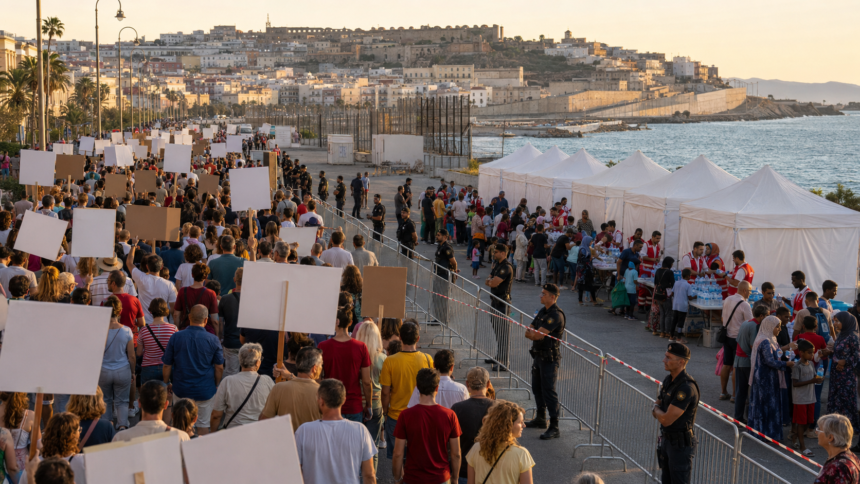
Tens of thousands of people have taken to the streets across Spain to demand a stronger government response to the worsening migration crisis in Ceuta, the Spanish enclave on the northern coast of Africa.
The demonstrations followed weeks of pressure on the city after large numbers of migrants and asylum seekers crossed the border from neighboring Morocco. The sudden arrivals have overwhelmed shelters, strained local services and intensified political debate over how Madrid and the European Union should manage migration at their southern borders.
In Ceuta, residents marched through the streets to express frustration over the government’s handling of the crisis and its consequences for the city. Solidarity demonstrations were also held elsewhere in Spain, with participants calling for urgent assistance for local authorities and humane treatment for migrants.
The latest crisis was triggered by a large-scale border surge in July, during which at least 72,000 people reportedly entered Ceuta from Morocco. The crossing left reception centers operating beyond capacity and forced some migrants to seek temporary shelter in public spaces or improvised facilities.
Local authorities have warned that the city lacks sufficient housing, medical resources and personnel to accommodate the new arrivals. Ceuta’s geographic position makes it one of the European Union’s most sensitive migration entry points, despite being located on the African continent.
The demonstrations reflected a range of political demands. Some protesters called for stronger border controls and greater support from the Spanish government, while humanitarian organizations emphasized the need to protect asylum seekers and prevent further deaths along increasingly dangerous migration routes.
The crisis has also revived tensions between Spain and Morocco over border management. Cooperation between the two countries is considered essential for controlling irregular crossings, but migration has repeatedly emerged as a source of diplomatic pressure between Madrid and Rabat.
Spain’s government is facing calls to transfer migrants from Ceuta to the mainland to ease pressure on the enclave. Such proposals remain politically sensitive, with critics arguing that transfers could encourage further crossings and supporters warning that overcrowded local facilities are becoming unsustainable.
The European Union is monitoring the situation as member states continue implementing their common migration and asylum reforms. Spain has argued that countries located along the bloc’s external borders should not be left to manage large-scale arrivals without greater financial and logistical support.
For Ceuta, the immediate priorities include expanding emergency accommodation, maintaining healthcare services and processing asylum applications. The protests underline growing public frustration with the prolonged crisis and the absence of a solution capable of balancing border security, humanitarian obligations and the needs of local communities.