


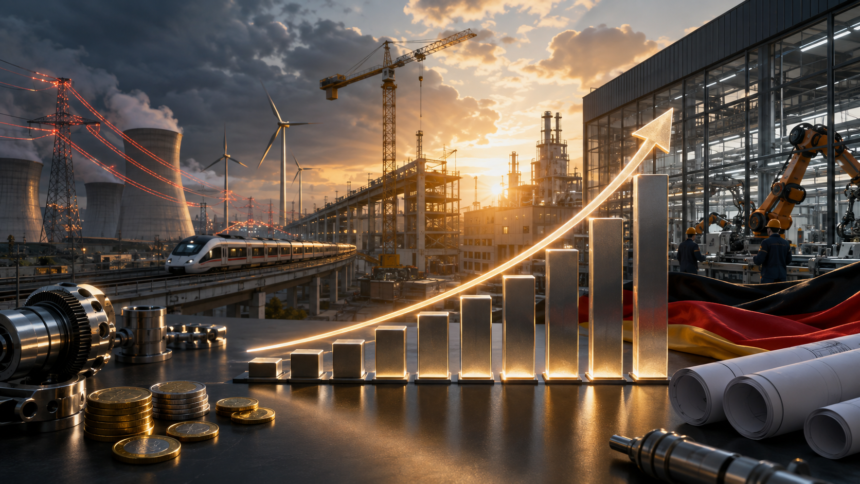
Germany’s Ifo Institute has raised its forecast for the country’s economic growth in 2026, pointing to stronger government spending, improving industrial production and better-than-expected economic activity during the first half of the year.
The Munich-based economic research institute now expects Germany’s gross domestic product to expand by 1.4% in 2026, compared with its previous projection of 0.8%. It also raised its forecast for 2027 to 1.2%, while predicting that growth will moderate to approximately 0.8% in 2028.
The improved outlook follows a stronger performance by Europe’s largest economy during the second quarter of 2026, when GDP increased by 0.3%. Industrial production has shown signs of recovery, while stronger demand from other European markets has provided additional support to German exporters.
Government expenditure is expected to become one of the principal drivers of the recovery. According to the institute, around €40 billion in additional public spending is being directed toward infrastructure, climate-related programs and defense, equivalent to approximately 0.8% of Germany’s economic output.
Higher infrastructure investment could provide support to construction, transportation and manufacturing while addressing longstanding concerns about aging roads, railways and public utilities. Increased defense spending is also expected to generate new orders for Germany’s industrial and technology sectors.
Despite the improved forecast, the economy continues to face significant risks. Rising energy prices are increasing operating costs for manufacturers and placing renewed pressure on household budgets, potentially limiting consumer spending.
Germany’s energy-intensive industries remain particularly exposed because chemicals, metals, glass and heavy manufacturing require large and reliable supplies of power. Higher costs could weaken their international competitiveness and delay investment decisions.
Inflation is also expected to remain above earlier projections. The Ifo Institute forecasts that consumer-price growth will reach approximately 2.8% in 2026 and rise to 3% in 2027 before easing to around 2.3% in 2028.
Persistent inflation could influence the European Central Bank’s interest-rate decisions and keep borrowing costs elevated for businesses and households. This would present another challenge for sectors such as housing and construction, which are particularly sensitive to financing conditions.
The revised forecast nevertheless provides a cautiously positive signal after several years of weak growth and economic uncertainty. Germany has struggled with high energy costs, subdued global demand, labor shortages and the expensive transition toward cleaner technologies.
The country’s recovery will depend on whether higher public investment translates into sustained private-sector activity and improved productivity. External risks—including geopolitical tensions, volatile energy markets and weaker international trade—could still undermine the expected expansion.
For now, the Ifo Institute’s revision suggests that Germany may be entering a gradual recovery, supported by public spending and a revival in industrial activity, even as inflation and energy costs continue to cloud the broader outlook.