

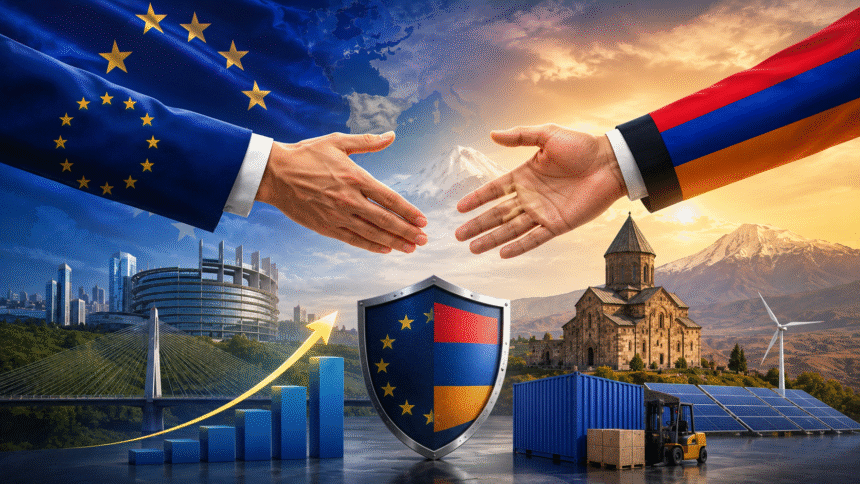
The European Union has announced plans to prepare an initial economic support package worth 50 million euros for Armenia, signaling growing European backing for Yerevan as it faces increasing political and economic pressure from Russia.
European Commission President Ursula von der Leyen confirmed that the financial package aims to help Armenia strengthen its economy, improve resilience, and reduce the impact of trade and economic pressures linked to its deteriorating relationship with Moscow.
The announcement comes at a sensitive moment for Armenia, which has been steadily deepening its ties with Europe while distancing itself from Russia politically and strategically. Over the past two years, Armenian Prime Minister Nikol Pashinyan’s government has expanded cooperation with the European Union in areas such as economic reform, democratic governance, border monitoring, and regional security.
European officials described the new support package as an important first step toward broader economic cooperation between Brussels and Yerevan. According to EU sources, the funds are expected to support infrastructure projects, economic modernization, energy development, and programs aimed at improving Armenia’s long-term financial stability.
The European Union has increasingly positioned itself as a key partner for Armenia following rising tensions between Yerevan and Moscow. Relations between the two countries have become strained over security disputes, regional conflicts, and Armenia’s growing criticism of Russia’s role in the South Caucasus.
Russian officials have repeatedly warned Armenia against moving too closely toward the European Union and Western institutions, arguing that such a shift could damage traditional alliances and economic cooperation frameworks that have existed since the Soviet era.
Moscow remains one of Armenia’s largest trading partners and continues to hold significant influence in sectors including energy, transportation, and banking. Analysts believe Russia could respond to Armenia’s European pivot through trade restrictions, economic pressure, or reduced political support in regional security matters.
Despite those concerns, the Armenian government continues to promote a policy of diversifying international partnerships and reducing excessive dependence on any single foreign power. Prime Minister Pashinyan has repeatedly emphasized that Armenia seeks balanced relations with all global partners while protecting its sovereignty and national interests.
European leaders view Armenia as an increasingly important partner in the South Caucasus, especially amid broader geopolitical competition between Russia and the West. The EU has also expanded diplomatic engagement in the region through monitoring missions and mediation efforts aimed at reducing tensions between Armenia and neighboring Azerbaijan.
While the announced package remains relatively modest in financial terms, observers say its political significance is much larger. The move sends a clear message that the European Union is prepared to support Armenia economically and diplomatically as the country gradually shifts closer toward Europe.
The coming months are expected to determine whether cooperation between Armenia and the European Union will deepen further or whether growing Russian pressure will complicate Yerevan’s European ambitions.