

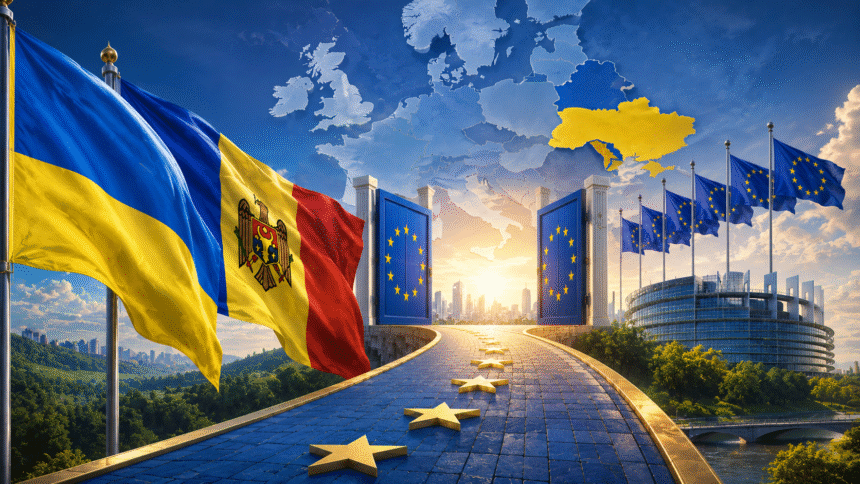
The European Union has taken a significant new step toward Ukraine’s potential membership after Hungary officially lifted its long-standing objection to opening accession negotiations with both Ukraine and Moldova, ending nearly 17 months of political deadlock inside the bloc.
The decision clears the path for formal membership negotiations to begin later this June, marking one of the most important political developments in the European Union since the start of the war between Russia and Ukraine.
European officials described the breakthrough as a major strategic and symbolic victory for Kyiv, reflecting Europe’s continued support for Ukraine amid ongoing military conflict and geopolitical tensions with Russia. The move also reinforces the European Union’s broader strategy of expanding its influence in Eastern Europe and strengthening partnerships with countries seeking closer ties with Brussels.
Hungary had previously blocked progress over concerns related to minority rights, economic implications, and disagreements with European Union policies regarding the war in Ukraine. However, after months of negotiations and diplomatic pressure from European leaders, Budapest agreed to remove its veto, allowing the accession process to move forward.
Ukrainian President Volodymyr Zelenskyy welcomed the development, calling it a “historic moment” for Ukraine and a clear signal that the country’s future lies within Europe. Moldovan officials also praised the decision, describing it as a major milestone in their efforts to deepen integration with European institutions.
European Commission officials emphasized that opening negotiations does not guarantee immediate membership, but rather begins a long and complex process involving political reforms, judicial restructuring, anti-corruption measures, and economic alignment with EU standards.
Despite the celebratory atmosphere in Kyiv and Brussels, the move is expected to increase tensions with Moscow. Russia has repeatedly criticized the European Union’s eastward expansion and warned that deeper Western integration of former Soviet states threatens regional stability and Russian strategic interests.
Analysts believe the timing of the decision carries strong geopolitical significance. As the war in Ukraine continues and Europe seeks to reduce Russian influence across the continent, accelerating Ukraine’s EU path has become both a political message and a strategic objective for European leaders.
The negotiations are expected to focus initially on governance reforms, economic standards, energy cooperation, and legal harmonization with EU laws. European officials stressed that both Ukraine and Moldova will still face major challenges before achieving full membership.
For Ukraine, the start of negotiations represents more than a diplomatic milestone. It is viewed domestically as recognition of the country’s sacrifices during the war and its determination to align itself with European political and economic systems.
The coming months are expected to define the pace and direction of the accession talks, while also testing the European Union’s ability to remain united on one of the bloc’s most politically sensitive expansion projects in decades.