


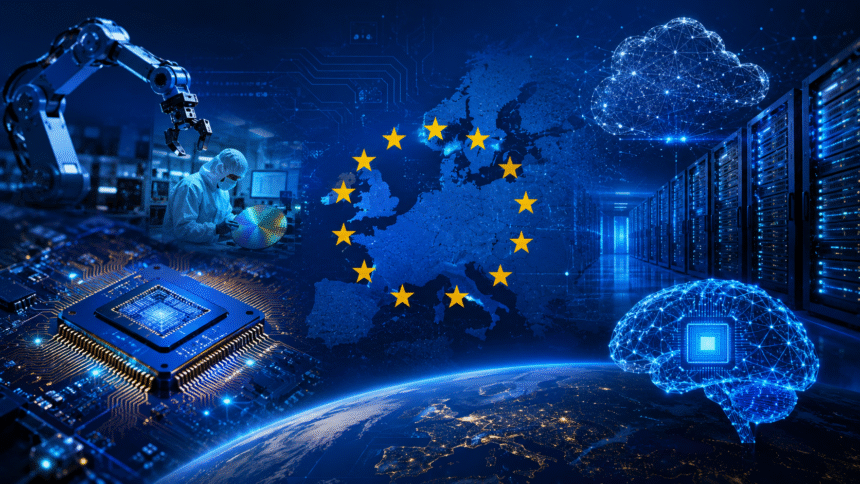
The European Union is accelerating efforts to achieve greater technological independence as concerns grow over the continent’s heavy reliance on American and foreign technology companies. The European Commission is now pushing forward with a broad strategic plan aimed at strengthening Europe’s digital sovereignty and building a more self-sufficient technology ecosystem.
According to European officials, the initiative focuses on several key sectors, including semiconductor manufacturing, artificial intelligence infrastructure, cloud computing, cybersecurity, and open-source software development. The plan is designed to reduce Europe’s dependence on major U.S. technology firms that currently dominate critical digital services and infrastructure across the continent.
One of the main priorities is the expansion of Europe’s semiconductor industry. European leaders believe that the global chip shortages experienced in recent years exposed the risks of relying heavily on Asian and American supply chains. Through major investments and incentives, the European Union hopes to increase domestic chip production and establish advanced semiconductor facilities within member states.
The European Commission is also increasing support for open-source software projects as part of a broader effort to create alternatives to proprietary platforms controlled by foreign corporations. Officials argue that open-source systems can improve transparency, cybersecurity, and long-term digital resilience while giving European governments and businesses greater control over sensitive data and infrastructure.
Artificial intelligence has become another central pillar of the strategy. The EU plans to invest heavily in AI research, supercomputing capabilities, and the construction of large-scale data centers capable of supporting next-generation technologies. European policymakers aim to position the continent as a global leader in “ethical AI,” emphasizing transparency, privacy protections, and regulatory oversight.
The push for technological independence comes amid rising geopolitical tensions and increasing competition between major global powers in areas such as AI, semiconductors, and digital infrastructure. European officials have repeatedly warned that excessive dependence on external technology providers could leave Europe vulnerable during political disputes, cyber conflicts, or economic disruptions.
At the same time, European companies and startups are expected to benefit from increased funding and industrial support programs under the new strategy. Analysts say the initiative could reshape Europe’s digital economy over the coming decade, although challenges remain, including high development costs, global competition, and the need for stronger coordination among EU member states.
Despite the ambitious goals, European leaders insist the strategy is not intended to isolate Europe from international partners, but rather to ensure the continent can maintain greater control over its technological future in an increasingly competitive and uncertain world.