The trade agreement between the European Union and Mercosur has entered provisional effect, opening a new phase in economic relations between Europe and South America while triggering fresh controversy among farmers, environmental groups, and several European governments.
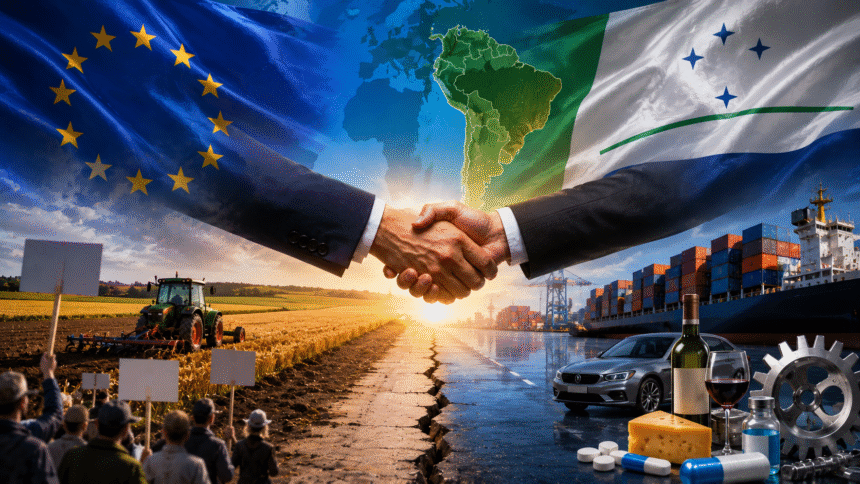
The agreement links the European Union with the Mercosur bloc, which includes Brazil, Argentina, Paraguay, and Uruguay. Together, the two sides represent one of the world’s largest trade partnerships, connecting hundreds of millions of consumers across two continents. The EU says the deal could boost European exports to Mercosur by 39% by 2040, especially in sectors such as cars, machinery, pharmaceuticals, chemicals, wine, and dairy products.
Supporters argue that the deal gives Europe a strategic economic opening at a time of rising global trade tensions. By expanding access to South American markets, the EU hopes to reduce dependence on China and the United States, while Mercosur countries gain better access to European goods, technology, and investment.
However, the agreement has also revived strong opposition inside Europe. Farmers in several EU countries fear that cheaper agricultural imports from South America — especially beef, poultry, sugar, and soy — could undercut local producers who must follow stricter EU environmental, animal welfare, and food safety rules.
The controversy is especially sensitive in countries with powerful farming sectors. France, Poland, Hungary, Ireland, and Austria have been among the strongest critics, warning that the agreement could weaken European agriculture and expose farmers to unfair competition. Poland has also challenged the deal at the European Court of Justice, arguing that its implementation raises legal and political concerns.
Environmental groups have also criticized the deal, warning that increased demand for South American beef and soy could worsen deforestation, especially in Brazil and surrounding regions. Critics argue that the agreement may conflict with Europe’s own environmental goals, including efforts to prevent imports linked to deforestation.
The European Commission, meanwhile, insists that the agreement includes safeguards and will benefit both sides. Brussels says provisional application allows European exporters and farmers to begin using the deal immediately, while maintaining monitoring mechanisms to address market disruptions. According to the Commission, the agreement began provisional application on May 1, 2026.
The debate shows how difficult trade policy has become for the European Union. On one side, Brussels wants new markets, stronger global partnerships, and more economic independence. On the other, many farmers and rural communities fear that free trade deals are being pushed at their expense.
The EU-Mercosur agreement may strengthen Europe’s global trade position, but it also exposes a deep internal divide: whether Europe should prioritize cheaper imports and export growth, or protect farmers, food standards, and environmental commitments. For now, the deal has entered force provisionally — but the political battle around it is far from over.