


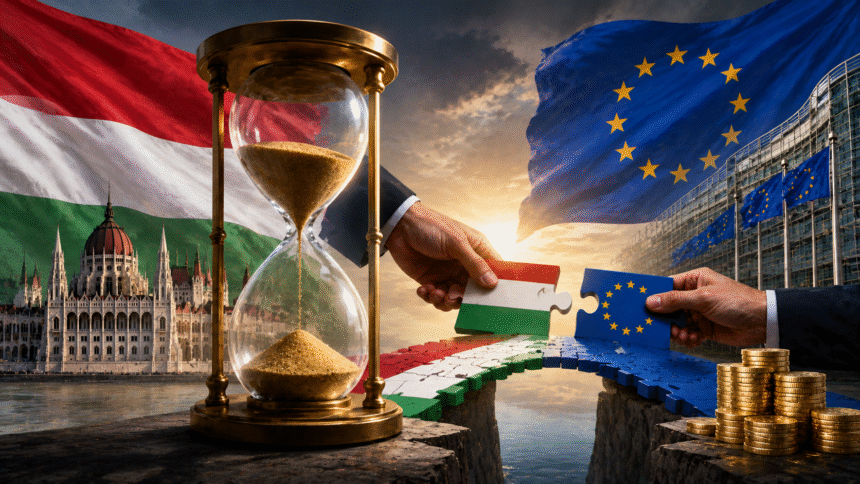
Hungary is facing a tight deadline to unlock €10.4 billion in European Union recovery funds, as Budapest works to meet EU conditions before the end of August and avoid losing access to money that could be crucial for its struggling economy.
The funds were previously frozen because of long-running EU concerns over the rule of law, corruption, judicial independence, and governance standards in Hungary. Brussels has repeatedly argued that EU money must be protected by strong oversight and legal safeguards before it can be released.
According to Reuters, the €10.4 billion package includes around €6.5 billion in grants and €3.9 billion in low-interest loans from the EU’s post-pandemic recovery fund. Hungary must meet key targets by August 31, 2026, although actual disbursement could continue until the end of the year if the requirements are approved in time.
The pressure on Budapest has increased because Hungary needs to submit a revised spending plan that matches EU recovery priorities, including green transition, digitalization, economic resilience, and institutional reforms. The previous plan became increasingly difficult to implement because of outdated timelines and unresolved political disputes with Brussels.
For Hungary, the money is not only a budgetary issue. It is also a major test of its relationship with the European Union. The frozen funds have weighed on investor confidence, public finances, and the Hungarian forint, while limiting the government’s ability to fund development projects and economic recovery programs.
EU officials believe the deadline is ambitious but still possible to meet. However, Hungary must move quickly to satisfy Brussels that the money will be spent transparently and in line with EU standards. That means improving oversight mechanisms, addressing corruption concerns, and ensuring that public institutions meet the required rule-of-law benchmarks.
The issue has also become politically sensitive. Hungary’s strained relationship with Brussels has been one of the most difficult files inside the European Union for years. The freezing of funds was designed to pressure Budapest into reforms, but it also affected municipalities, civil society groups, and projects that depend on EU financing.
If Hungary succeeds, the release of the funds could provide a major economic boost. It would help finance infrastructure, digital projects, environmental programs, and other recovery measures. It could also strengthen market confidence and reduce pressure on the national currency.
If it fails, Hungary risks losing access to a significant share of the recovery money, deepening economic pressure and prolonging its political dispute with the European Union.
The race for the €10.4 billion has therefore become more than a financial deadline. It is a test of whether Hungary can repair its relationship with Brussels, meet EU governance standards, and secure the funding needed to support its economic recovery.