

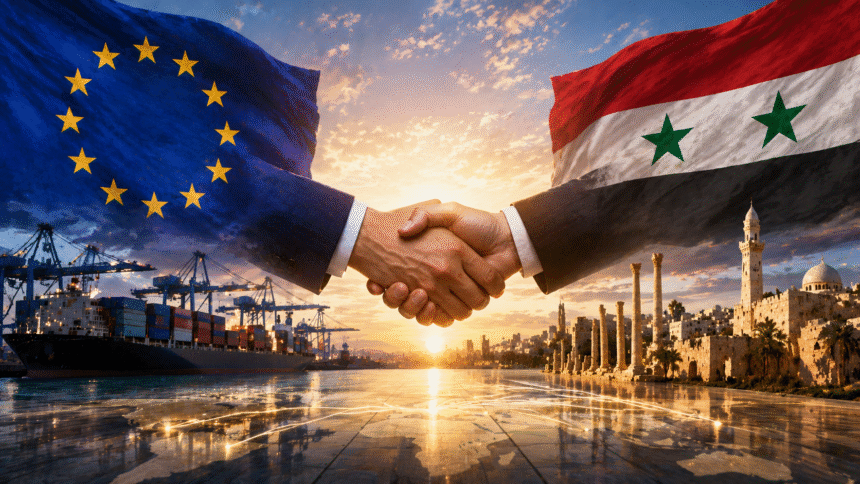
The European Union has agreed to restore broader trade relations with Syria, marking one of the most significant shifts in European policy toward Damascus since the outbreak of the Syrian war in 2011.
The decision was adopted by EU foreign ministers in Brussels and ends the partial suspension of the EU-Syria cooperation agreement, which had been frozen after the Syrian uprising turned into a long civil war. The European Council said the move represents an important step toward strengthening relations between the European Union and Syria.
According to the EU, the decision sends a clear political signal that Europe is ready to re-engage with Syria and support its economic recovery after years of war, destruction, sanctions, and isolation. The move comes as Syria seeks to rebuild its economy and return to international markets following major political changes in Damascus.
The restoration of trade ties is expected to ease restrictions on imports of Syrian goods, including oil and petroleum products, gold, precious metals, and diamonds. This could open the door for greater commercial activity between Syria and European markets, although the recovery process remains complicated by damaged infrastructure, weak institutions, and the long-term impact of war.
The decision also reflects a broader European recalculation. For years, EU policy toward Syria was shaped mainly by sanctions, humanitarian aid, and diplomatic isolation. Now, Brussels appears to be moving toward a more practical approach focused on reconstruction, economic stabilization, and political dialogue.
The timing is also important. EU officials met with Syria’s top diplomat Asaad al-Shaibani in Brussels as part of a renewed high-level political dialogue. This suggests that the trade decision is not only an economic measure, but part of a wider attempt to rebuild formal channels between Europe and Damascus.
For Syria, renewed trade relations with Europe could provide a major boost to its struggling economy. Years of war have damaged production, trade routes, energy supplies, and public services. Access to European markets and investment could help revive some sectors, create jobs, and support reconstruction efforts.
However, the decision may also face criticism. Some European voices remain concerned about human rights, political accountability, and the risk of normalizing relations too quickly. Others argue that Syria cannot recover without international engagement and that continued isolation would only deepen economic collapse and civilian suffering.
The EU’s move does not mean that all political concerns have disappeared. Rather, it signals that Brussels is willing to separate parts of economic recovery from the wider political file, while still keeping pressure on Damascus over governance, stability, and human rights.
In practical terms, the restoration of fuller trade ties could mark the beginning of a new phase in EU-Syria relations. After more than a decade of sanctions and diplomatic distance, Europe is now testing whether economic engagement can help stabilize Syria and support its return to the regional and international stage.