

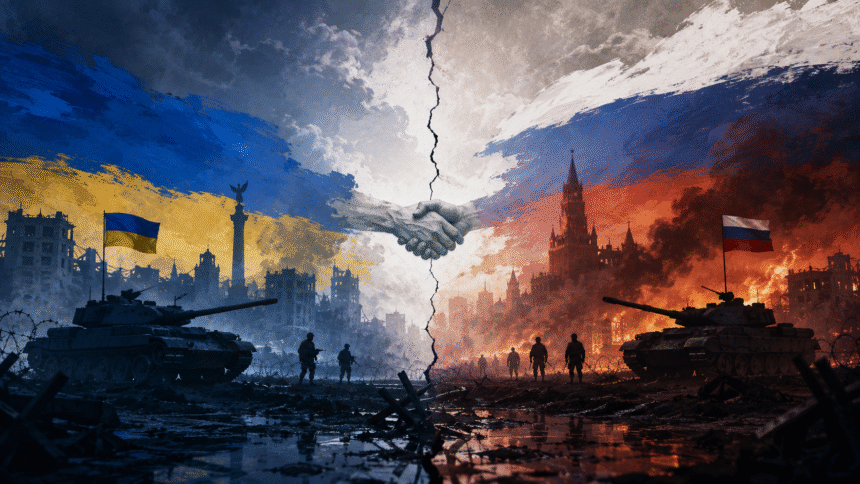
Moscow and Kyiv have exchanged accusations of violating a U.S.-backed ceasefire, raising new doubts about the possibility of achieving even a temporary pause in the war.
The ceasefire was proposed as part of American efforts to reduce escalation between Russia and Ukraine and create space for diplomatic talks. However, both sides quickly accused each other of continuing attacks, showing how fragile the agreement remains on the ground.
Ukraine said Russian forces continued drone strikes, artillery attacks, and battlefield operations despite the announced pause. Ukrainian officials reported clashes along several parts of the front line, while also accusing Moscow of using the ceasefire as a political tool rather than a real commitment to de-escalation. (Reuters)
Russia, meanwhile, denied responsibility for the breakdown and accused Ukraine of launching attacks during the ceasefire period. Moscow said its forces had responded to Ukrainian actions and claimed to have intercepted Ukrainian drones, while insisting that Kyiv was the side undermining the truce.
Although military activity reportedly decreased in some areas, the fighting did not stop completely. This partial reduction suggested that the ceasefire may have lowered the intensity of the conflict, but failed to establish a reliable or enforceable halt to hostilities.
The latest accusations highlight a recurring problem in the Russia-Ukraine war: temporary ceasefires are often announced, but without strong monitoring mechanisms or trust between the two sides, they quickly become vulnerable to collapse. Previous pauses in fighting have also been followed by mutual accusations and renewed military escalation.
For Washington, the failure to fully implement the ceasefire is a setback to its diplomatic push. The United States has been trying to create conditions for a wider peace process, but the continued fighting shows that battlefield realities remain stronger than diplomatic declarations.
The dispute also comes as both sides continue to hold firm to their political and territorial positions. Ukraine insists that any peace process must respect its sovereignty and territorial integrity, while Russia continues to demand major concessions, particularly in eastern Ukraine.
For civilians, the continued violations mean that the humanitarian cost of the war remains unchanged. Even a limited ceasefire can provide brief relief for frontline communities, allow evacuations, and support prisoner exchanges, but without a lasting agreement, those gains remain temporary.
The exchange of accusations between Ukraine and Russia shows that the war is still far from a political solution. The ceasefire may have reduced military activity in some places, but it also exposed the deep mistrust that continues to block any meaningful path toward peace.