

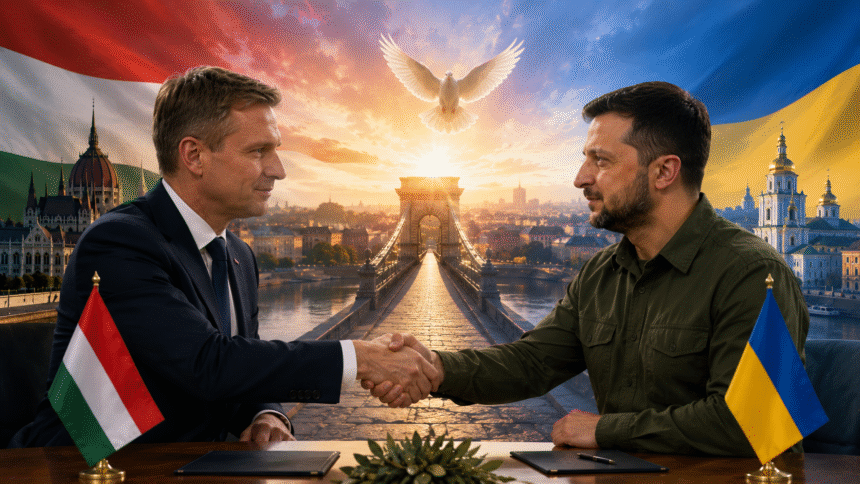
Signs of a major diplomatic shift may be emerging in Eastern Europe after newly elected Hungarian Prime Minister Peter Magyar announced his willingness to meet Ukrainian President Volodymyr Zelenskyy next week in what could become the first serious attempt to reset relations between Budapest and Kyiv in years.
The announcement has attracted significant attention across Europe because relations between Hungary and Ukraine deteriorated sharply during the long tenure of former Hungarian Prime Minister Viktor Orbán, whose government frequently clashed with both Kyiv and European Union leaders over issues related to the war in Ukraine, sanctions against Russia, NATO policy, and minority rights.
Peter Magyar’s statement is being viewed by many analysts as an early signal that Hungary could begin adopting a more cooperative and less confrontational foreign policy approach toward Ukraine and its Western allies.
Speaking to local media, Magyar emphasized the need to “open a new chapter” in bilateral relations and suggested that dialogue between neighboring countries was necessary to improve regional stability during one of Europe’s most dangerous geopolitical periods since the Cold War.
Relations between Hungary and Ukraine became increasingly tense after Russia’s invasion of Ukraine in 2022. While most NATO and European Union members strongly backed Kyiv militarily and politically, Viktor Orbán’s government maintained a more cautious and often controversial position. Budapest repeatedly criticized some EU sanctions packages against Russia, opposed certain military aid initiatives, and resisted deeper NATO involvement in the conflict.
Hungary’s stance frequently frustrated both Ukrainian officials and European allies, who accused Orbán of undermining European unity during the war. Kyiv, meanwhile, criticized Budapest over what it viewed as excessive political closeness to Moscow.
Disputes between the two countries were also fueled by long-standing disagreements regarding the ethnic Hungarian minority living in western Ukraine’s Zakarpattia region. Budapest accused Kyiv of limiting minority language and education rights, while Ukraine argued that its policies were necessary to strengthen national unity during wartime.
Peter Magyar’s rise to power has already generated speculation about whether Hungary may gradually reposition itself closer to the European mainstream on Ukraine-related issues. Although analysts caution that major policy changes may not happen immediately, many believe the new leadership could seek to reduce tensions with Brussels and improve Hungary’s international standing.
European officials have welcomed the possibility of renewed dialogue between Budapest and Kyiv, viewing it as a potentially important step toward restoring greater unity within the European Union and NATO during the continuing war with Russia.
At the same time, observers note that Hungary’s domestic political environment remains deeply divided. Orbán’s years in power left behind strong nationalist and conservative political networks, and any major shift in foreign policy could face resistance from parts of Hungarian society and political institutions.
For Ukraine, improving relations with Hungary could carry strategic importance as Kyiv continues seeking stronger European integration, military support, and diplomatic backing from all EU member states.
The proposed meeting between Magyar and Zelenskyy is expected to be closely watched across Europe, not only for its symbolic significance but also for what it could reveal about Hungary’s future role inside the European political landscape.
After years of political tension, diplomatic disputes, and mutual distrust, the possibility of direct dialogue now raises cautious hopes that one of Eastern Europe’s most strained regional relationships may finally be entering a new phase.