

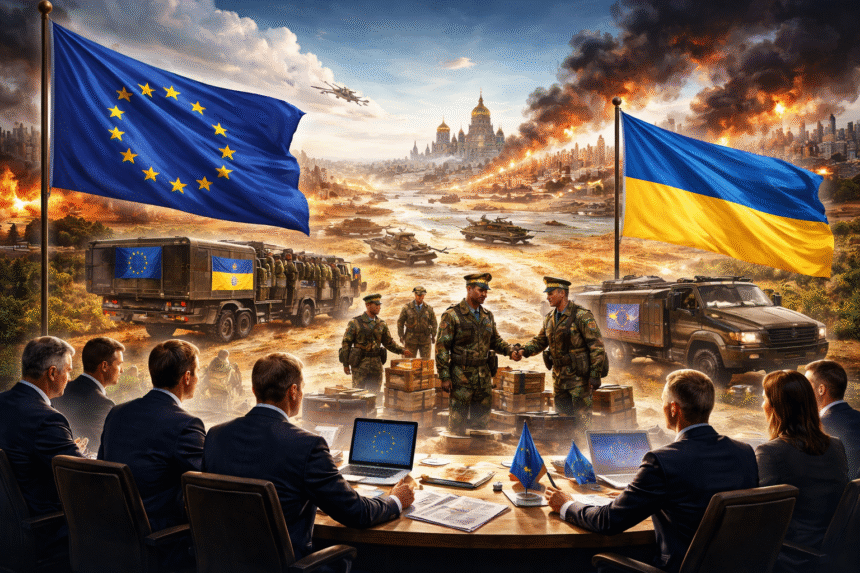
The European Union has reaffirmed its unwavering political and military support for Ukraine, even as internal divisions among member states persist over funding mechanisms and long-term commitments. The renewed backing underscores the bloc’s strategic priority of maintaining pressure on Russia while safeguarding European security.
During recent high-level meetings, EU leaders emphasized that support for Ukraine remains non-negotiable, framing it as essential not only for Ukraine’s sovereignty but also for the stability of the broader European order. Military aid, financial assistance, and humanitarian support continue to flow, reflecting a collective commitment despite differing national interests.
However, behind this unified front, disagreements have surfaced regarding the scale, structure, and sustainability of funding packages. Some member states have raised concerns about the economic burden of continued assistance, particularly amid rising inflation and domestic budget constraints. Others argue that sustained support is critical to prevent a prolonged conflict that could ultimately prove more costly for Europe.
Debates have also emerged over how funds should be allocated—whether through joint EU mechanisms or bilateral contributions—highlighting deeper questions about burden-sharing and fiscal responsibility within the union. These differences, while significant, have not derailed the EU’s overall position.
European officials have worked to bridge these gaps through compromise, exploring flexible funding arrangements and phased commitments that accommodate varying national capacities. The goal is to maintain unity while ensuring that Ukraine receives the resources needed to continue its defense and reconstruction efforts.
Analysts note that the EU’s ability to sustain support despite internal disagreements reflects a broader recognition of the geopolitical stakes involved. A weakened Ukraine, they warn, could embolden further instability in the region, making unity—however imperfect—a strategic necessity.
As the conflict continues, the European Union faces the ongoing challenge of balancing internal cohesion with external commitments. For now, its message remains clear: despite disagreements, support for Ukraine will endure.