

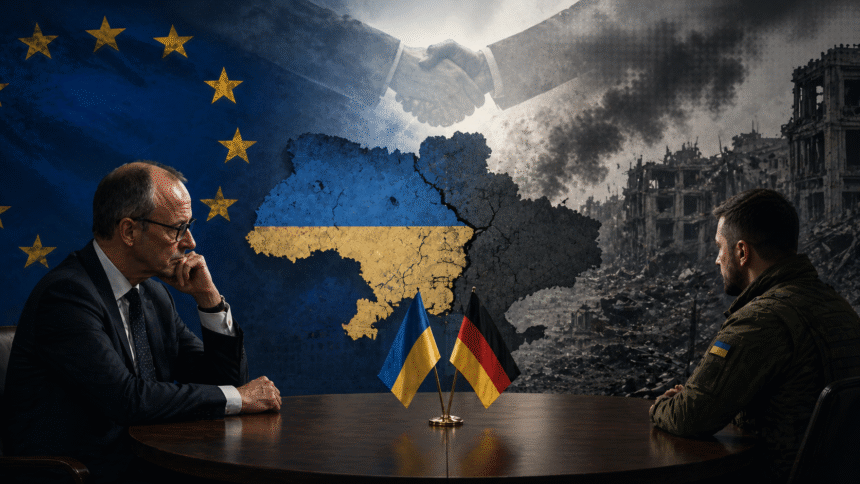
German Chancellor Friedrich Merz has opened a sensitive debate over the future of Ukraine’s war settlement, suggesting that Kyiv may one day have to accept that parts of its territory could remain outside its control as part of a peace agreement with Russia. His remarks connect two difficult issues at once: ending the war and keeping Ukraine’s path toward European Union membership alive.
Speaking to students in Marsberg, Merz said that Ukraine would eventually need a ceasefire agreement and, later, a peace treaty with Russia. He indicated that such a settlement could leave some Ukrainian territory no longer under Kyiv’s authority. While the statement does not represent a formal peace plan, it marks one of the clearest acknowledgments from a major European leader that Ukraine’s future borders may become part of a painful political compromise.
The German chancellor framed the issue around Ukraine’s European future. He argued that EU accession while Ukraine remains at war is not realistic, meaning that ending the conflict would be a basic condition for moving Kyiv closer to membership. At the same time, Merz made clear that EU entry would not happen quickly, ruling out rapid accession in 2027 or 2028 and stressing that Ukraine must still meet requirements on rule of law, governance, and anti-corruption reforms.
For Ukraine, the political cost of such a discussion is enormous. Any suggestion of accepting territorial loss touches the deepest wounds of the war and would face strong resistance from many Ukrainians who view occupied regions as inseparable parts of the state. Merz also implied that President Volodymyr Zelenskyy would need to explain any future compromise directly to the Ukrainian public, possibly through a referendum, because no settlement involving territory could be treated as a simple diplomatic decision.
The remarks also reflect a wider European dilemma. Western governments want to support Ukraine against Russian aggression, but they are also searching for a realistic path to end a war that has drained military resources, disrupted Europe’s security order, and delayed Ukraine’s EU ambitions. Merz’s comments suggest that some European leaders may be preparing public opinion for a settlement based not on full victory, but on a ceasefire line, security guarantees, and gradual integration with European institutions.
Still, the idea carries major risks. If territorial concessions are seen as rewarding Russia’s invasion, it could weaken the principle that borders cannot be changed by force. It could also encourage Moscow to treat occupied territory as leverage in future negotiations. For Kyiv and its allies, the challenge will be to balance the urgent need to end the war with the need to avoid a settlement that legitimizes aggression or leaves Ukraine vulnerable to renewed attacks.
Merz’s message is therefore not only about Ukraine’s borders, but about Europe’s political limits. It signals that the road to peace may require choices that are painful, controversial, and deeply unpopular — while Ukraine’s EU dream may depend not only on reform and resilience, but also on how the war is eventually frozen, ended, or settled.