


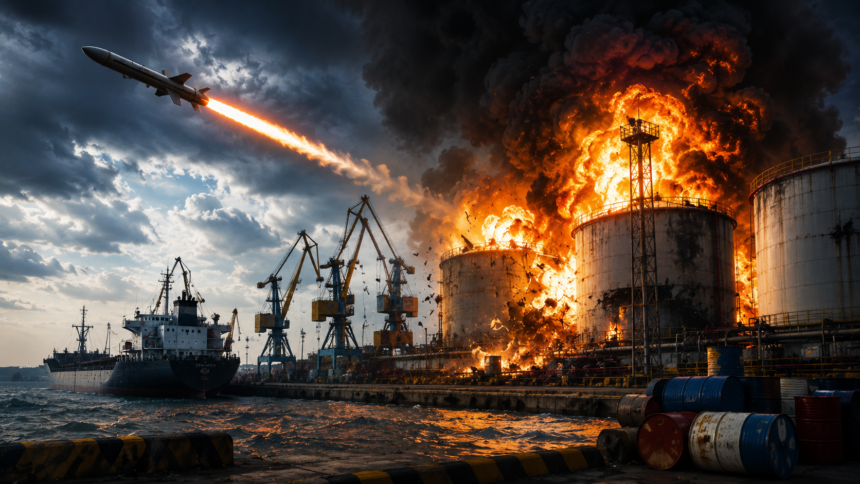
Russia has intensified attacks on Ukraine’s Black Sea logistics network, targeting port infrastructure and fuel-storage facilities at Chornomorsk, one of the country’s strategically important maritime hubs in the Odesa region.
Russia’s Defence Ministry said its forces struck fuel and lubricant storage facilities as well as military equipment warehouses at Chornomorsk during an overnight operation earlier this month. Moscow claimed the facilities were being used to support the Ukrainian armed forces. The Russian claims about the precise targets and damage have not been independently verified.
The attack forms part of a wider Russian campaign against Ukrainian ports and shipping infrastructure along the Black Sea. Chornomorsk, together with Odesa and other ports in the region, plays an important role in Ukraine’s commercial trade and agricultural exports, making disruption to maritime infrastructure economically significant as well as militarily sensitive.
Russian attacks have increasingly affected Ukraine’s ability to move agricultural products by sea. Ukrainian officials have said previous strikes destroyed tens of thousands of tonnes of grain at Chornomorsk, while attacks on vessels and port facilities have substantially disrupted cargo traffic.
The pressure is already being reflected in Ukraine’s export figures. Reuters reported last week that Ukrainian grain exports in August had fallen 76% year-on-year amid what has effectively become a renewed disruption of Black Sea shipping. Ukraine is one of the world’s major exporters of wheat, corn and other agricultural commodities, raising concerns that prolonged interruptions could have consequences beyond the country itself.
The latest fighting around maritime infrastructure is also part of a growing cycle of attacks by both sides. Ukraine has increasingly targeted Russian oil, military and port facilities with long-range drones and missiles. Russia’s Black Sea port of Novorossiysk, an important hub for Russian and Kazakh oil exports, recently suspended some operations following a Ukrainian drone attack before loading resumed.
Russia, meanwhile, has continued striking Ukrainian ports, energy installations and industrial facilities. A Russian attack on the Danube port of Izmail on August 13 damaged infrastructure and disrupted electricity supplies, adding further pressure on Ukraine’s alternative export routes.
The escalating attacks have turned Black Sea infrastructure into an increasingly important front in the wider conflict. Ukraine has sought to undermine Russia’s energy revenues and military logistics, while Moscow appears determined to restrict Kyiv’s access to maritime trade and damage infrastructure supporting the Ukrainian economy and war effort.
Kyiv has consequently proposed a ceasefire covering the Black Sea aimed at stopping attacks on civilian targets and commercial shipping. The proposal comes amid mounting concern about the security of international shipping and the potential impact of continued disruption on global food supplies.
For Ukraine, protecting Chornomorsk and its other southern ports is therefore about more than maintaining military supply lines. These facilities remain critical gateways to international markets, meaning sustained attacks could deepen the economic consequences of a war that has already severely damaged the country’s infrastructure and export capacity.