

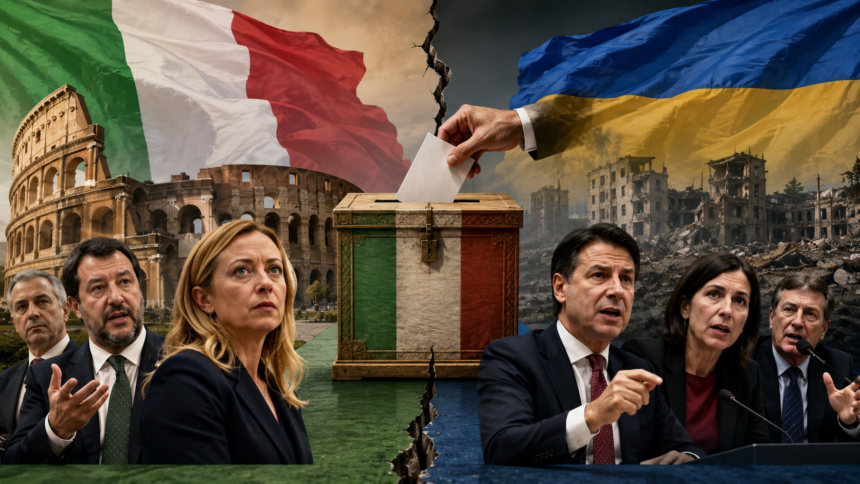
Italy’s support for Ukraine is emerging as an increasingly divisive issue ahead of the country’s 2027 general election, as political forces on both the right and the opposition begin challenging the continuation of military assistance to Kyiv. The debate is turning foreign policy into a domestic electoral battleground and exposing divisions within both of Italy’s main political camps.
Prime Minister Giorgia Meloni has remained one of Ukraine’s more consistent supporters within the European Union since taking office in 2022. Her government has backed Kyiv politically and militarily while maintaining Italy’s commitment to NATO and European efforts to support Ukraine against Russia.
But maintaining that position is becoming more politically complicated as the election approaches.
Within Meloni’s governing coalition, the League, led by Deputy Prime Minister Matteo Salvini, has long been more skeptical about sending weapons and expanding defense spending. The debate has intensified around Italy’s participation in European defense initiatives, including the EU’s SAFE program, with the League questioning the financial burden and arguing that Italy should devote greater attention to security challenges in the Mediterranean and its southern neighborhood.
Pressure is also coming from nationalist forces further to the right. Roberto Vannacci, whose National Future movement is attempting to build an electoral constituency to the right of Meloni, has adopted positions critical of continued support for Ukraine. According to polling cited by Le Monde, Meloni’s Brothers of Italy remains the strongest individual party at around 27%, while National Future has reached approximately 7%, creating another source of pressure on the prime minister’s right flank.
The divisions are equally significant within the opposition.
Former prime minister Giuseppe Conte, leader of the Five Star Movement, has increasingly positioned himself against continuing arms deliveries to Ukraine. Conte has argued that Italy should place greater emphasis on negotiations and has proposed allowing center-left voters to influence the coalition’s position on Ukraine through primary elections.
That position puts him at odds with Elly Schlein, leader of the center-left Democratic Party, who supports continued assistance to Kyiv. Schlein, however, also faces pressure from pacifist elements within her own political camp, making Ukraine one of the issues complicating attempts to build a unified opposition coalition capable of challenging Meloni.
The political importance of the issue is reinforced by Italian public opinion. Resistance to higher military spending and rearmament remains substantial, influenced by concerns over inflation, stagnant wages and Italy’s longstanding pacifist political traditions. These domestic pressures give parties campaigning against additional military commitments an issue that can be connected directly to voters’ economic concerns.
Ukraine could therefore become intertwined with a broader debate over how Italy should spend its resources: on military assistance and European defense, or on domestic priorities such as wages, public services and economic support.
The implications extend well beyond Rome. Italy is the European Union’s third-largest economy and a major NATO member. Any significant change in its policy toward Kyiv could affect European efforts to maintain political and military support for Ukraine, particularly if similar electoral pressures emerge elsewhere in Europe.
For Meloni, the challenge will be balancing her established pro-Ukraine and Atlanticist foreign policy with increasingly skeptical elements of the Italian electorate and her own political coalition. For the opposition, the same issue threatens to expose fundamental disagreements between the Democratic Party and the Five Star Movement.
With Italy’s next general election due in 2027 — and political maneuvering already intensifying — support for Ukraine is no longer simply a foreign-policy question. It is becoming an electoral test of what role Italians want their country to play in Europe’s confrontation with Russia.