


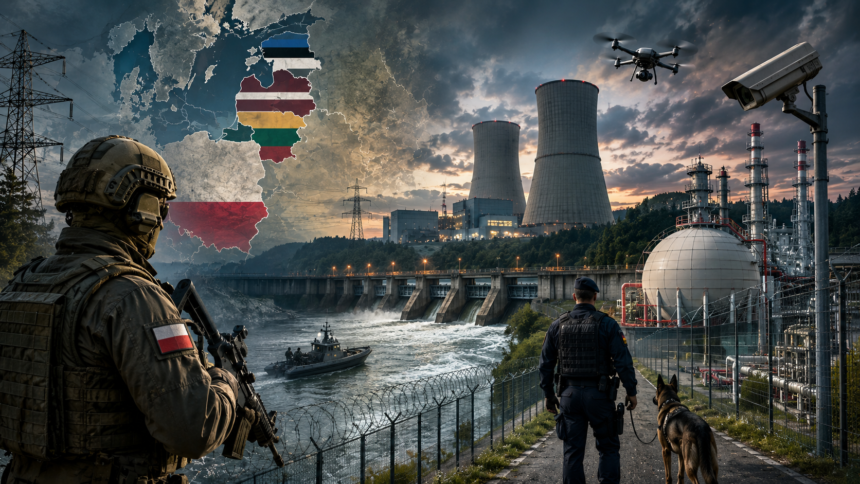
Poland and the three Baltic states — Lithuania, Latvia and Estonia — are strengthening security around critical infrastructure amid mounting concern that strategically important facilities could become targets of sabotage or staged attacks linked to Russia.
The measures cover some of the region’s most sensitive assets, including power plants, dams, natural gas facilities and energy networks. According to Reuters, officials and intelligence services are particularly concerned about a scenario in which an attack could be disguised as Ukrainian action, creating confusion over responsibility and potentially testing NATO’s response.
The concerns are part of a broader security challenge facing NATO’s eastern flank. European intelligence agencies have repeatedly warned about suspected hybrid operations involving sabotage, arson, disinformation and drones as Russia’s war against Ukraine continues. Moscow has rejected accusations that it is preparing such operations and has described Western warnings about Russian threats as attempts to generate fear.
Lithuania has taken some of the most visible precautions. Military forces have been deployed to help protect strategically important energy infrastructure as authorities increase surveillance and preparedness around facilities considered vulnerable to attack.
In neighboring Latvia, authorities have reinforced protection around the Daugava River hydroelectric infrastructure and the Inčukalns underground gas storage facility, a strategically important part of the Baltic region’s energy system. Security agencies are paying particular attention to the possibility that drones or other relatively inexpensive methods could be used against infrastructure with significant economic or political importance.
Poland is also reviewing vulnerabilities in its energy system. Major energy companies, including oil group Orlen and gas infrastructure operator Gaz-System, have been examining supply routes and security arrangements as the regional threat assessment changes. Polish authorities are simultaneously confronting suspected disinformation campaigns, including forged documents connected to the country’s planned nuclear power project.
Officials are especially concerned about the potential use of “false-flag” operations. In such a scenario, an attack could be carried out in a way designed to make another country appear responsible. Reuters reported that regional governments are examining the possibility of attacks involving Ukrainian drones or weapons that could then be presented as evidence that Ukraine had targeted NATO territory.
Such an incident could create a particularly dangerous situation for NATO. Poland, Lithuania, Latvia and Estonia are all members of the alliance, meaning a serious attack on their territory could immediately raise questions about collective defense and attribution. A deliberately ambiguous incident could therefore be intended not only to damage infrastructure but also to create political confusion among NATO governments.
The heightened security comes as European authorities investigate a wider pattern of suspicious incidents involving drones, fires and attempts to disrupt critical infrastructure. Governments increasingly describe the threat as hybrid warfare, where conventional military pressure is combined with sabotage, cyber operations and information campaigns designed to destabilize societies without triggering a traditional military confrontation.
For Poland and the Baltic states, geography makes the threat particularly sensitive. All four countries sit on NATO’s eastern frontier, while Lithuania, Latvia and Estonia share a long history of security concerns regarding Russia. Poland and Lithuania also surround Russia’s heavily militarized Kaliningrad region.
The latest precautions therefore represent more than routine infrastructure security. They reflect a growing concern that Europe’s confrontation with Russia could increasingly extend beyond the Ukrainian battlefield, with power networks, dams, gas facilities and other civilian infrastructure becoming potential fronts in a broader struggle involving sabotage, drones and disinformation.
Protecting those facilities is consequently becoming an increasingly important element of NATO’s deterrence strategy — not simply to prevent physical damage, but to ensure that an ambiguous or staged incident cannot easily generate confusion or division within the alliance.