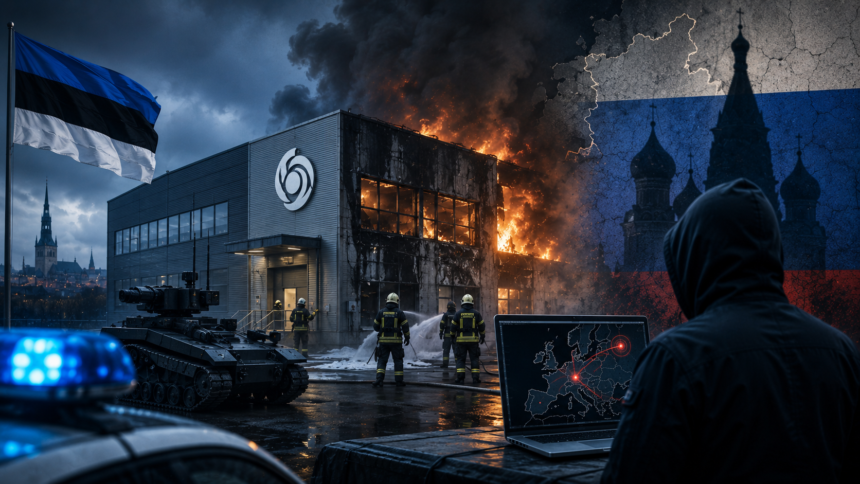
Estonian authorities are investigating whether Russia may have been involved in a suspected arson attack on a building used by Milrem Robotics, a major Estonian defense technology company whose unmanned military systems have been deployed in Ukraine. Officials stress that Russian responsibility has not been established and the investigation remains at an early stage.
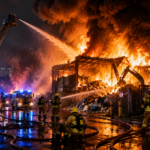
The fire broke out late Friday at a Milrem Robotics facility on Betooni Street in Tallinn. According to Estonia’s public broadcaster ERR, a local resident reported suspicious activity near the building shortly before emergency services were alerted. Preliminary evidence indicates that the blaze may have been deliberately started.
Estonian Prosecutor General Astrid Asi said investigators from the Internal Security Service and the North Prefecture have identified suspects. Prosecutors have also asked a court to order their detention as investigators examine several possible motives, including whether the incident constituted an attempted act of sabotage.
Prime Minister Kristen Michal confirmed that a possible Russian connection is among the scenarios being examined by investigators. However, Estonian authorities have not publicly presented evidence establishing that Moscow ordered or participated in the incident. No injuries were reported.
The identity of the target makes the investigation particularly sensitive. Milrem Robotics specializes in robotic and autonomous military systems, including its THeMIS unmanned ground vehicle, which can perform logistics, reconnaissance and other battlefield-support missions. The company’s unmanned systems have been supplied to and deployed in Ukraine.
The incident comes amid heightened concern across Europe about sabotage and other forms of so-called hybrid warfare connected to Russia’s confrontation with Western countries supporting Ukraine. Poland, Lithuania and other European governments have previously investigated fires, infrastructure attacks and other incidents for potential links to Russian intelligence or Russian-directed networks.
That broader context, however, does not establish responsibility for the Tallinn fire. Estonian investigators are still working to determine who organized the suspected arson, what motivated the perpetrators and whether they acted independently or on behalf of a foreign actor.
The investigation is therefore likely to attract close attention from Estonia’s NATO allies. Estonia shares a border with Russia and has been among Europe’s strongest supporters of Ukraine since Moscow launched its full-scale invasion in February 2022.
For Tallinn, the case is not simply a criminal investigation into a fire at an industrial facility. If investigators ultimately establish foreign involvement, the incident could become part of a wider European security debate over protecting defense manufacturers and other strategically important infrastructure from covert attacks.
For now, however, the central question remains unresolved: the fire is being investigated as suspected arson and possible sabotage, but Russian involvement has not been proven.