


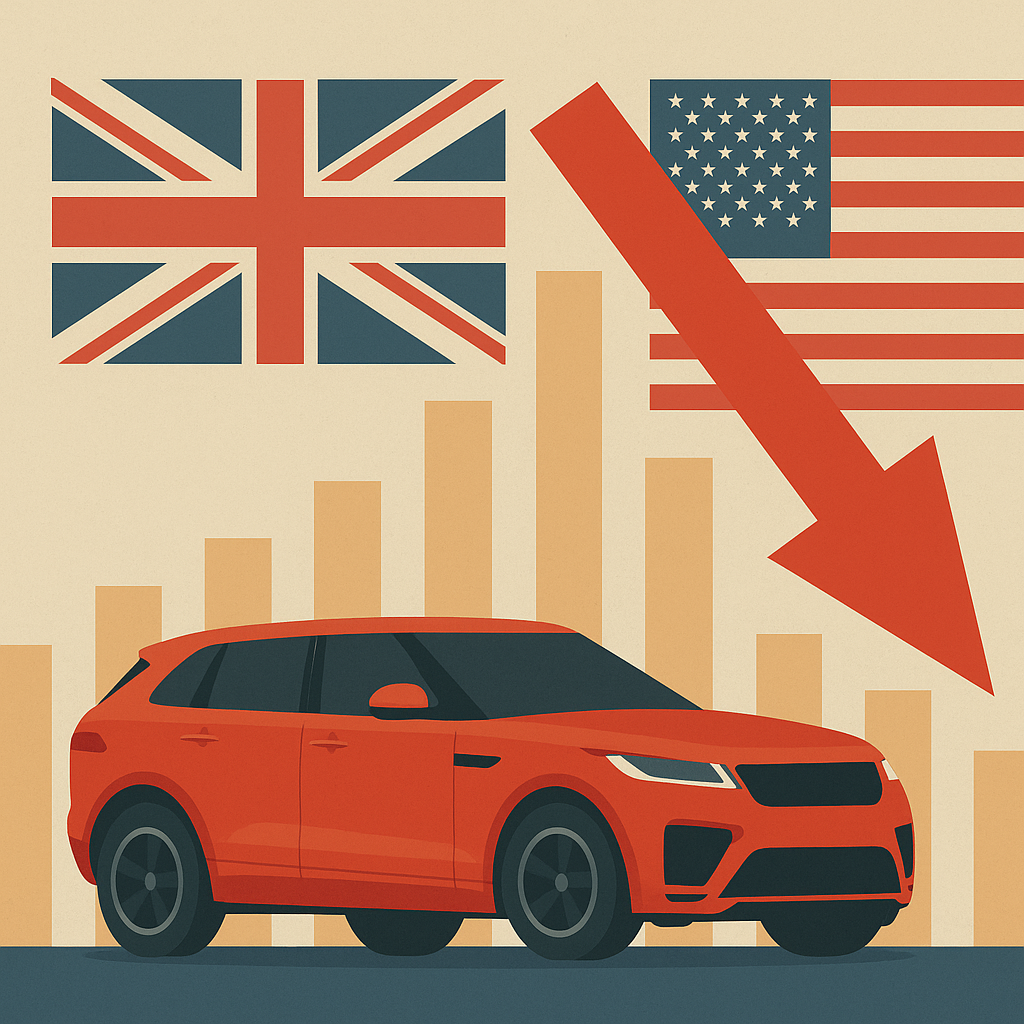
Jaguar Land Rover (JLR) reported a sharp decline in quarterly profits as steep U.S. tariffs and trade-related disruptions took a toll on the British carmaker’s financial performance. The company’s challenges come as it undergoes a major leadership change and prepares for a full transition to electric vehicles.
For the fiscal quarter ending in June, pre-tax profits dropped by 49% year-on-year to £351 million, down from £689 million the previous year. The company’s operating profit margin fell to 4%, compared to 8.9% in the same quarter of 2024, primarily due to a £254 million hit from the 27.5% tariff imposed by the U.S. on vehicles imported from the UK.
Tariff Impact and Trade Pause
In response to the tariff and pending UK-US trade negotiations, JLR temporarily suspended shipments to the U.S. in April, contributing to a 9.2% drop in revenue to £6.6 billion. Although the luxury automaker, owned by India’s Tata Motors, resumed exports in late June, the damage to Q2 earnings was already done.
Under the new trade agreement that took effect at the end of June, the U.S. agreed to cut tariffs from 27.5% to 10% on the first 100,000 UK-built vehicles. However, because the agreement came into force only late in the quarter, its financial benefits will be seen in the coming months.
“We welcome the deals that have been done, and they will provide certainty for us to plan around,” said Richard Molyneux, JLR’s Chief Financial Officer, during Tata Motors’ earnings call. He also noted ongoing talks to improve the tariff quota system for 2026.
Leadership Transition
The earnings report comes amid a change in leadership at JLR. Earlier this week, PB Balaji, Chief Financial Officer of Tata Motors, was named the new Chief Executive Officer of JLR, succeeding Adrian Mardell, who retired after a three-year tenure.
Mardell is credited with delivering JLR’s strongest annual profits in a decade for the 2024 financial year and spearheading the rebranding of Jaguar, which included a controversial yet ambitious move toward full electrification by the end of the decade.
Balaji’s appointment had been planned for some time, as he has served on JLR’s board since 2017. His elevation signals continuity in Tata’s long-term strategy for the luxury carmaker, particularly as it navigates both geopolitical trade headwinds and industry-wide electrification pressures.
Outlook
Despite the setback, JLR reaffirmed its annual operating profit margin guidance of 5% to 7%, expecting improved conditions in the second half of the year following tariff relief under the new UK-US trade deal.
As the company continues to push forward with its electric transformation and expands its global strategy under new leadership, all eyes will be on how it navigates lingering trade challenges and maintains profitability in a volatile global market.