

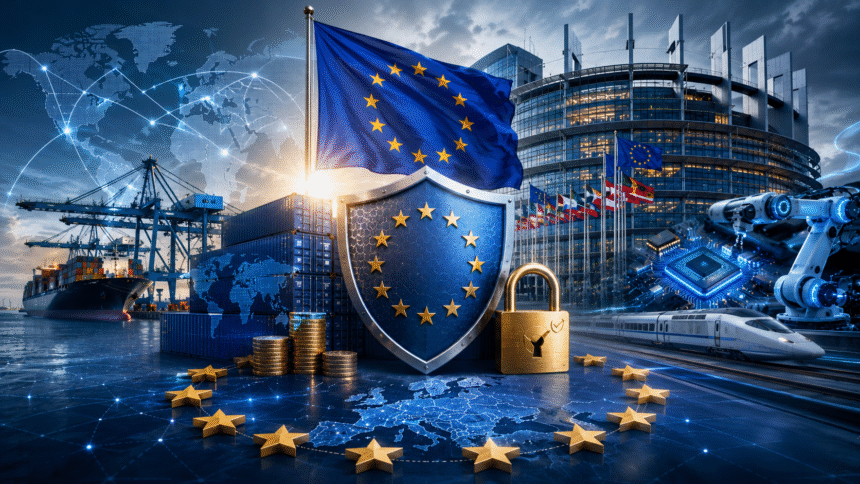
The European Parliament has approved new rules to strengthen the European Union’s screening of foreign investments, marking a major step in Europe’s effort to protect critical infrastructure, advanced technology, and sensitive industries from security and political risks.
The legislation is designed to ensure that foreign direct investment into the EU does not threaten public order or security. It comes at a time when European governments are increasingly concerned about strategic assets falling under the influence of foreign powers, especially in sectors linked to energy, transport, defense, artificial intelligence, semiconductors, critical raw materials, and communications networks.
Under the new framework, all 27 EU member states will be required to maintain screening mechanisms for sensitive investments. This is a significant change because the EU’s previous system relied heavily on coordination between national governments, leaving gaps in how different countries examined foreign acquisitions. The new rules aim to create a more consistent European approach while still allowing member states to make final decisions on individual investments.
The move reflects a broader shift in EU economic policy. For years, Europe promoted openness to foreign capital as a strength of its single market. But recent geopolitical tensions, supply chain shocks, cyber risks, and concerns about economic coercion have pushed Brussels to rethink how open strategic sectors should be. The message is not that Europe is closing its doors to investment, but that access to sensitive assets will face closer scrutiny.
China is a central part of the debate, even when not named directly in every provision. European officials have become more cautious about foreign ownership in ports, telecoms, energy grids, high-tech manufacturing, and cybersecurity infrastructure. Beijing has criticized the direction of EU policy, with Chinese officials warning that investment restrictions could damage economic cooperation between China and Europe.
The rules also fit into a larger European economic security agenda. Brussels is exploring ways to reduce dependence on single suppliers in critical sectors and diversify supply chains, especially where China dominates key inputs such as critical minerals, components for electric vehicles, semiconductors, and military-related technologies.
Supporters of the new framework argue that foreign investment can no longer be judged only by financial value. A takeover of a port, chip company, data center, energy supplier, or defense-linked manufacturer may create long-term security risks even if the deal appears commercially attractive. The new rules are meant to help governments identify those risks earlier and coordinate responses before strategic assets are transferred.
Businesses, however, may face more complex procedures. Stricter screening could increase legal uncertainty for mergers and acquisitions, especially for companies operating across several EU countries. Investors may need to provide more information about ownership structures, funding sources, links to foreign governments, and the strategic purpose of the investment.
The challenge for the EU will be balance. Europe wants to remain attractive to global investors, but it also wants to prevent foreign capital from becoming a tool of political pressure or strategic dependency. The new rules show that Brussels is moving toward a more defensive economic model, where market openness is increasingly tied to national security and geopolitical risk.
The European Parliament’s approval sends a clear message: Europe still welcomes investment, but not at the cost of control over its most sensitive sectors. As global competition intensifies, the EU is trying to protect the foundations of its economy before they become points of vulnerability.