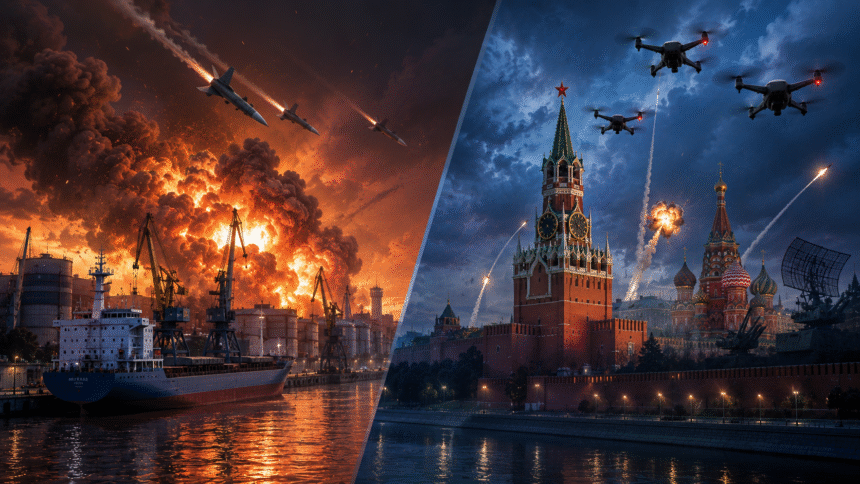
Russia launched a new air attack on Ukraine’s Danube port city of Izmail, damaging port infrastructure in the Odesa region, while Russian authorities said they intercepted four Ukrainian drones heading toward Moscow. The incidents mark another escalation in a war increasingly fought far beyond the front line, targeting ports, supply routes, energy facilities, and major urban centers.
Izmail is one of Ukraine’s most important river ports. Located on the Danube River near the Romanian border, it has become a crucial route for Ukrainian trade since Russia’s invasion disrupted access to parts of the Black Sea. For Kyiv, the Danube corridor is not just a commercial outlet; it is a wartime lifeline for exports, logistics, and connections with European markets.
The latest Russian strike caused damage to port infrastructure but did not immediately result in major destruction or casualties, according to reports. Still, the target itself is significant. By striking Izmail, Moscow is pressuring Ukraine’s alternative export routes and signaling that even river ports away from the main battlefield remain vulnerable.
At the same time, Moscow said its air defenses shot down four Ukrainian drones that were heading toward the Russian capital. The reported drone activity near Moscow comes shortly after one of the largest Ukrainian drone attacks on the Moscow region in more than a year, which killed several people, according to Russian officials.
The exchange highlights the growing role of drones in the war. Ukraine has increasingly used unmanned systems to hit Russian logistics, air defenses, oil infrastructure, and military-linked facilities. Reuters reported that Ukrainian mid-range strikes are disrupting Russian military logistics and forcing Moscow to spread its air defenses across a wider area.
For Russia, attacks on Ukrainian ports serve both military and economic purposes. Damaging port infrastructure can slow exports, raise shipping risks, and increase pressure on Ukraine’s economy. It also sends a message to European states that support Kyiv, especially those close to the Danube corridor, that the war’s consequences can reach sensitive trade and border areas.
The escalation also has wider implications for Europe. Any disruption to Ukrainian ports can affect grain flows, shipping insurance, regional transport networks, and food supply chains. Because Izmail is located near NATO member Romania, repeated strikes in the area also increase concern about accidental spillover or cross-border security risks.
Both Russia and Ukraine deny deliberately targeting civilians, but the pattern of attacks shows how the war has expanded into a contest of infrastructure, endurance, and psychological pressure. Ports, oil refineries, drones, air defenses, and border regions have become central to the conflict alongside the traditional battlefield.
The strike on Izmail and the drone activity near Moscow underline a dangerous shift: the war is no longer limited to eastern and southern Ukraine. It is spreading through the air, across supply chains, and into strategic locations far from the front. For Europe, this means the conflict remains not only a Ukrainian crisis, but a continuing threat to regional security and economic stability.