


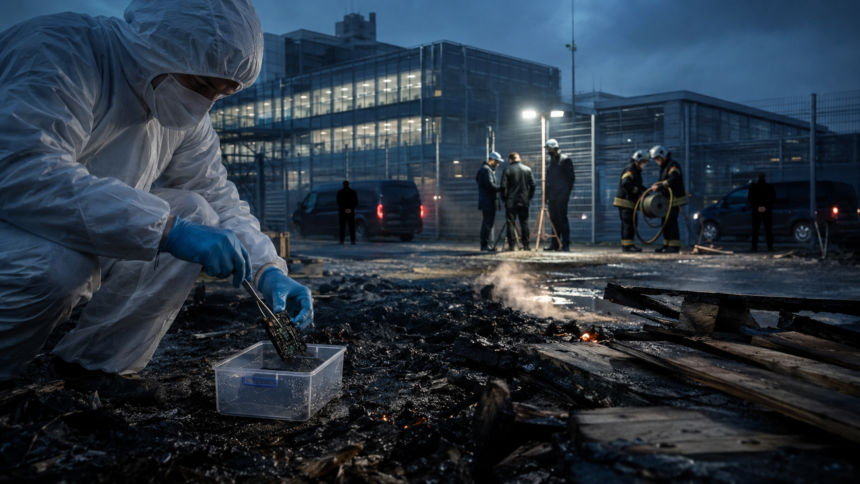
German authorities are investigating a suspected arson attack near the Munich headquarters of Rohde & Schwarz, a leading technology company involved in secure communications, cybersecurity and defense systems.
Police detained two people after a fire broke out at a construction site close to the company’s premises. The suspects were identified as a 28-year-old woman and a 38-year-old man, both Bulgarian nationals. The blaze was brought under control without causing significant damage.
Despite the limited impact of the fire, its proximity to a strategically important defense-technology company prompted authorities to examine whether the incident could be connected to recent suspected sabotage operations targeting German facilities.
Investigators have not publicly established a link between the two detained individuals and any foreign government, extremist organization or previous attack. Officials are considering multiple possible motives and have emphasized that the inquiry remains at an early stage.
Rohde & Schwarz develops advanced equipment used in secure communications, electronic warfare, cybersecurity and drone detection. The company’s role in Germany’s defense and security sectors has increased the sensitivity surrounding the incident.
The investigation comes amid growing concern over a series of suspicious events involving critical infrastructure and defense-related sites across Germany. Authorities have recently examined suspected attempts to disrupt electricity networks in Brandenburg and North Rhine-Westphalia.
Germany has also accused Russia of involvement in an attempted drone attack targeting a Ukrainian cargo aircraft at Leipzig/Halle Airport. Moscow has denied the accusation and described the German claims as politically motivated.
German security officials have warned that foreign states could use criminal groups or domestic extremists as intermediaries to conduct sabotage while concealing those ultimately responsible. This method forms part of what European governments describe as “hybrid warfare,” which can include cyberattacks, disinformation, espionage and physical disruption.
The heightened threat environment has led Germany to strengthen security around military suppliers, transportation hubs, energy networks and other strategically important facilities. European governments are also increasing intelligence cooperation to identify potential cross-border connections between suspicious incidents.
The Munich case will depend on forensic findings, surveillance recordings and information recovered from the suspects. Investigators are expected to examine whether the fire was deliberately started, how the construction site was accessed and whether the company itself was the intended target.
No injuries were reported, and the operations of Rohde & Schwarz were not believed to have suffered significant disruption. Nevertheless, the incident has added to concerns about the vulnerability of Europe’s defense industry as geopolitical tensions continue to rise.
German authorities have urged against speculation while the investigation proceeds. Until evidence establishes a wider connection, the possibility that the incident was an isolated criminal act remains under consideration.