

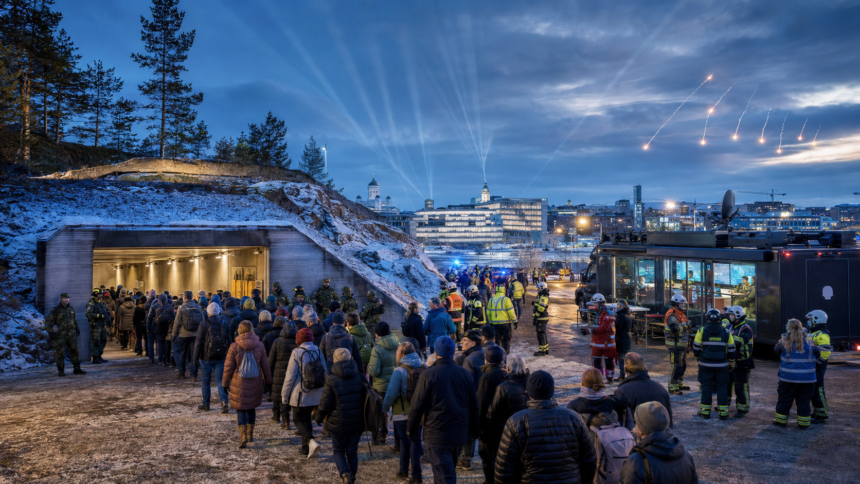
Finland has conducted what has been described as Europe’s largest civil defense exercise since the Cold War, bringing together more than 2,000 participants to test the country’s ability to respond to missile strikes, cyberattacks and a major national emergency.
The exercise took place in the eastern Finnish city of Kuopio and involved military conscripts, emergency personnel, volunteers, students and local residents. Participants rehearsed coordinated responses to disrupted communications, damaged infrastructure and other threats that could affect essential public services during a large-scale crisis.
One of the central scenarios involved moving civilians into an underground shelter capable of accommodating approximately 7,000 people. Finland maintains an extensive network of shelters designed to protect the population during military attacks and other emergencies, particularly in densely populated urban areas.
The drill also tested responses to cyberattacks targeting digital services, communications systems and critical infrastructure. Authorities assessed how government agencies, emergency services and civilian organizations would continue operating if electricity, transportation or telecommunications networks were disrupted.
Finland has intensified its security preparations amid heightened tensions with neighboring Russia and growing European concerns over sabotage, suspicious drone activity and cyber operations. The country shares a border of more than 1,300 kilometers with Russia, making national preparedness a longstanding priority.
Its accession to NATO further strengthened cooperation with Western allies while accelerating investment in military and civilian defense. Finnish authorities nevertheless emphasize that public preparedness remains essential because emergency services may be placed under severe pressure during the opening stages of a crisis.
Citizens are encouraged to maintain enough food, water, medicine and other supplies to remain self-sufficient for at least 72 hours. Schools and community organizations also provide training intended to ensure that emergency preparedness becomes part of everyday public awareness.
Finland’s defense strategy combines a large reserve force, compulsory military service and close coordination between government institutions, private companies and civil society. This comprehensive approach is designed to keep the country functioning during war, cyber disruption, natural disasters or other national emergencies.
The Kuopio exercise reflects a broader shift across Europe as governments reassess their readiness for threats extending beyond conventional warfare. Missile attacks, cyber operations and disruption of energy networks are increasingly treated as interconnected risks requiring coordinated military and civilian responses.
Finnish officials say the exercise was intended to identify weaknesses, improve communication between agencies and ensure that civilians understand their responsibilities during an emergency. The scale of the drill demonstrates Helsinki’s determination to strengthen national resilience as Europe enters a period of prolonged security uncertainty.