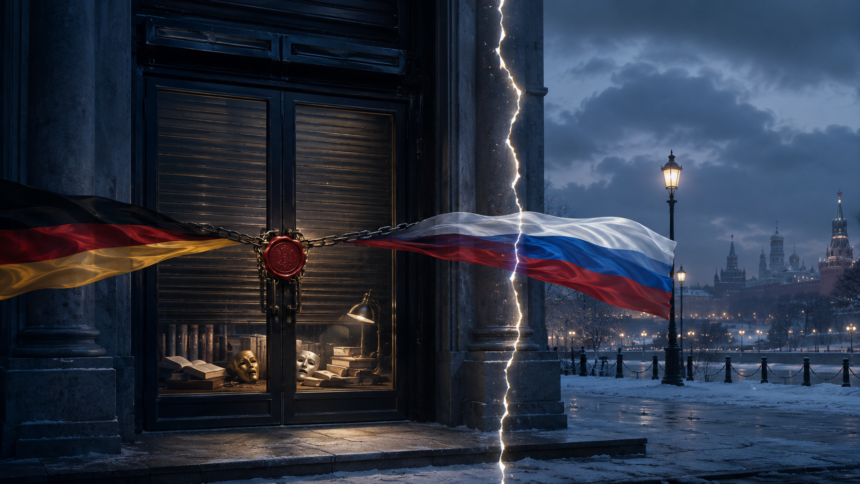
Russia has announced the closure of German cultural institutions operating on its territory, including branches of the Goethe-Institut, in retaliation for Germany’s decision to shut down the Russian Consulate in Bonn and a Russian cultural center in Berlin.
The move marks a new escalation in the diplomatic confrontation between Moscow and Berlin, whose relations have deteriorated sharply amid the war in Ukraine and mounting German accusations of Russian-linked hostile activities inside Europe.
The affected Goethe-Institut centers include branches in Moscow, St. Petersburg and Yekaterinburg. The organization promotes the German language and supports cultural and educational exchanges around the world, making the closures a significant setback for cultural cooperation between the two countries.
Moscow described Germany’s actions against Russian diplomatic and cultural institutions as unjustified and politically motivated. Russian officials said the decision to close the German centers was a reciprocal response intended to demonstrate that restrictions imposed on Russian organizations would not go unanswered.
Berlin’s measures followed allegations that Russia was involved in an attempted drone attack targeting a Ukrainian cargo aircraft at Leipzig/Halle Airport. German authorities have treated the incident as a serious national-security threat, while Moscow has firmly denied responsibility and accused Germany of presenting fabricated or politically driven claims.
The dispute comes as German investigators examine a series of suspicious incidents involving defense-related facilities, electricity infrastructure and transportation networks. European officials have increasingly warned that Russia may be conducting hybrid operations—including cyberattacks, sabotage and disinformation—to pressure governments supporting Ukraine.
Russia has rejected those allegations and accused European countries of using them to justify additional sanctions and diplomatic restrictions. The Kremlin has maintained that Western governments are responsible for the continued deterioration of relations by increasing military assistance to Kyiv and limiting Russian diplomatic activities.
The closure of cultural institutions illustrates how the confrontation is expanding beyond traditional diplomacy and economic sanctions. Language programs, academic cooperation and cultural exchanges that previously maintained connections between Russian and German societies are now becoming casualties of the broader geopolitical dispute.
European Union officials are meanwhile considering further sanctions against Russian individuals and organizations suspected of supporting military or intelligence operations. Any new measures will require unanimous approval from the bloc’s 27 member states.
With both Moscow and Berlin adopting reciprocal restrictions, prospects for restoring normal diplomatic and cultural relations appear increasingly limited. The latest closures reinforce the depth of the divide between Russia and Europe as security tensions surrounding Ukraine continue to spread into other areas of bilateral relations.