


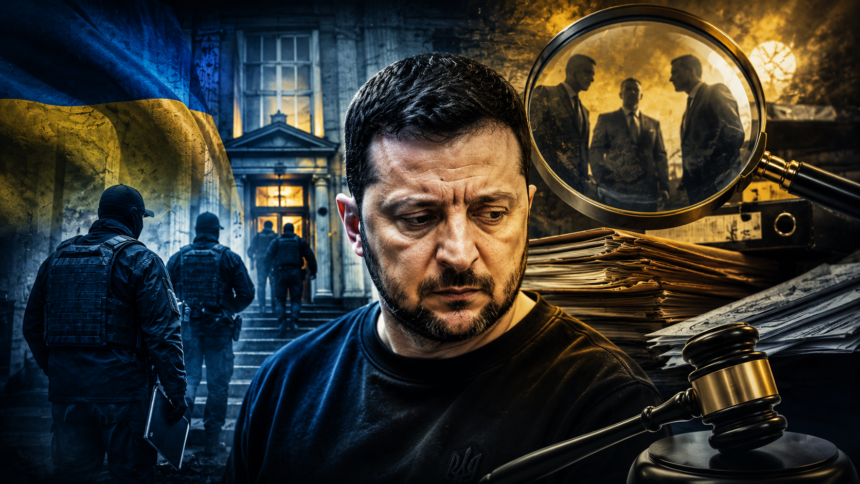
KYIV, August 19, 2026 — President Volodymyr Zelenskyy’s administration is facing renewed political pressure after Ukraine’s leading anti-corruption agencies launched an operation targeting an alleged criminal organization involving current and former lawmakers as well as senior officials connected to the presidential office.
The National Anti-Corruption Bureau of Ukraine (NABU) announced Wednesday that it was conducting a special operation aimed at exposing the alleged network. The agency said the group was linked to a current member of parliament, a former lawmaker and high-ranking figures within the President’s Office. Investigators said additional details would be released as the operation develops.
According to the Kyiv Independent, citing a law-enforcement source familiar with the investigation, NABU investigators searched premises connected to Iryna Mudra, a deputy head of the presidential office, and lawmaker Vadym Stolar. Searches were also reported at locations associated with former MP Maksym Mykytas and the state-owned Sense Bank. The searches do not by themselves establish guilt, and the investigation remains ongoing.
The latest operation comes at a particularly sensitive moment for Zelenskyy. Ukraine is still fighting Russia’s full-scale invasion while simultaneously facing growing domestic debate over corruption, government accountability and the concentration of political power in Kyiv.
The controversy surrounding Ukraine’s anti-corruption institutions has already generated significant political tensions. In July 2025, legislation reducing the independence of NABU and the Specialized Anti-Corruption Prosecutor’s Office (SAPO) triggered large demonstrations. The government subsequently reversed course, and parliament restored the agencies’ independence following the public backlash.
Since then, corruption investigations have continued to reach senior political circles. Earlier cases have involved allegations concerning officials and figures close to the government, increasing scrutiny of Zelenskyy’s ability to demonstrate that Ukraine’s anti-corruption institutions can operate independently even when investigations approach the highest levels of power.
The issue carries significance beyond Ukraine’s domestic politics. Kyiv’s progress on corruption and judicial reform remains closely watched by its European and Western partners as Ukraine seeks continued financial and military assistance and pursues membership in the European Union.
The latest investigation also arrives amid a broader political challenge to Zelenskyy. Former Defense Minister Mykhailo Fedorov, dismissed in July, has publicly called for Ukraine to develop a legal mechanism for holding presidential elections despite the war, while criticizing corruption and what he described as systemic problems in governance.
Taken together, the corruption investigations and growing debate over wartime political leadership are creating a difficult environment for Zelenskyy. While none of the latest allegations establishes wrongdoing by the president himself, investigations reaching officials associated with his administration could intensify demands for greater transparency and accountability.
For Ukraine, the stakes are particularly high: the government must maintain political stability and international confidence while fighting a major war, pursuing European integration and demonstrating that institutions designed to combat corruption remain capable of investigating powerful figures without political interference.