

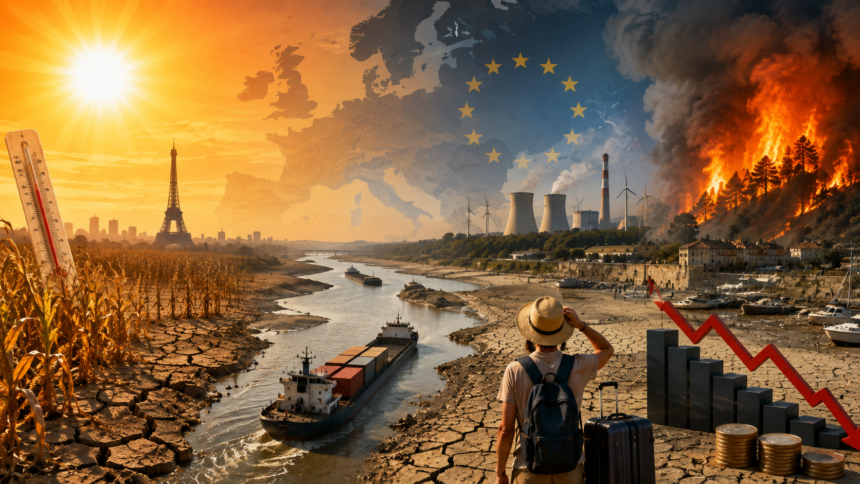
Europe’s extreme summer is rapidly becoming more than an environmental emergency. Record heat, prolonged drought and widespread wildfires are now disrupting transportation, electricity generation, agriculture, tourism and worker productivity, raising fears that climate-related losses could erase much of the European Union’s expected economic growth in 2026.
A new estimate from Dutch lender Triodos Bank suggests that this summer’s extreme heat and drought could reduce EU economic output by around 1% of GDP — approximately €180 billion. That figure is roughly equivalent to the economic growth the bloc had been expected to generate this year, meaning the effects of the extreme weather could effectively wipe out much of that expansion.
The economic damage is spreading across several sectors simultaneously. Europe’s major rivers, which function as vital commercial transport corridors, have been hit particularly hard by declining water levels. The Rhine, one of Germany’s most important industrial arteries, has experienced conditions that restrict how much cargo vessels can safely carry, increasing transportation costs for commodities and industrial goods.
The Danube is experiencing similar pressure. Exceptionally low water levels have disrupted navigation and created problems for energy infrastructure and communities across Central and Eastern Europe. The European Commission’s Joint Research Centre said on August 12 that worsening drought and record heat were producing exceptionally low river flows across parts of the continent.
Energy production has also been affected. High river temperatures and reduced water availability have complicated the cooling of power stations, particularly nuclear plants, while unusually hot and calm weather can simultaneously reduce wind generation. The combination places electricity networks under pressure precisely when demand for air conditioning and cooling is increasing.
France provides one of the clearest examples of the financial consequences. French Environment Minister Monique Barbut said the country’s recent heatwaves alone could generate €10 billion to €15 billion in direct and indirect economic costs, while drought has left tens of thousands of people facing water shortages.
Agriculture is another major casualty. Extreme temperatures and depleted soil moisture are damaging crops and reducing yields across several European regions. Farmers face a combination of lower production, higher irrigation costs and increasing uncertainty about future harvests. These pressures can eventually reach consumers through higher food prices.
Tourism, one of southern Europe’s most important industries, is also increasingly exposed. Wildfires and dangerous temperatures can force evacuations, close tourist areas and discourage visitors from travelling during what has traditionally been Europe’s peak holiday season. River tourism has also suffered, with low water levels forcing some cruise operators on the Rhine and Danube to modify or cancel itineraries.
Wildfires have added another layer of economic destruction, damaging homes, forests, businesses and infrastructure while forcing governments to spend heavily on firefighting and emergency response. Western Europe experienced its warmest combined June-July period on record in 2026, according to data cited from the EU’s Copernicus Climate Change Service.
Perhaps the largest economic effect, however, comes from something less visible: lost productivity. Workers become less productive as temperatures rise, particularly in construction, agriculture, manufacturing and other sectors involving physical labor. Triodos identified reduced labor productivity as a major contributor to its estimate of roughly €180 billion in potential economic losses.
The consequences could extend to government finances and monetary policy. Governments may face higher spending on disaster relief, infrastructure adaptation and support for affected industries, while food and electricity disruptions can contribute to inflationary pressures. Reuters reported that the scale of this summer’s damage is increasing concerns about government budgets and creating additional complications for European policymakers.
The European summer of 2026 therefore illustrates how climate extremes can move rapidly through an interconnected economy. A drought that begins as a shortage of rainfall can lower rivers, restrict shipping, reduce electricity generation, damage crops, disrupt tourism and ultimately weaken economic growth.
Europe’s heatwave is no longer simply a story about temperatures. It is becoming a test of the continent’s economic resilience — and a warning that the financial cost of extreme weather is already arriving.