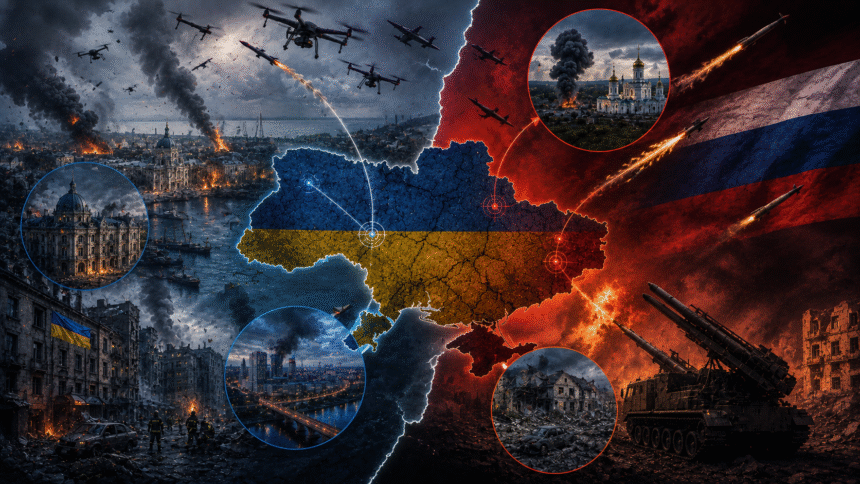
Russian missile and drone strikes on Ukraine’s northern Chernihiv and Sumy regions killed four people and injured several others, according to Ukrainian officials, in the latest wave of attacks on border areas and civilian infrastructure. The strikes show how northern Ukraine remains exposed to repeated Russian fire despite being far from the heaviest fighting in the east and south.
In the Chernihiv region, officials said a ballistic missile struck the centre of the town of Pryluky, killing two people and injuring at least 17 others, including a 14-year-old. The attack damaged civilian areas and added to growing concern over Russia’s continued use of missiles against towns beyond the main battlefield.
In the Sumy region, Ukrainian authorities reported that a Russian drone attack killed two more people and injured others. Sumy lies close to the Russian border and has repeatedly come under shelling, missile strikes, and drone attacks since the early stages of the war. Its location has made it one of the most vulnerable regions in northern Ukraine.
The attacks came as Russia continued a broader campaign of missile and drone strikes across Ukraine. On the same day, Russian attacks were also reported in other regions, including Kharkiv, Dnipropetrovsk, Mykolaiv, Zaporizhzhia, and the Danube port city of Izmail, where infrastructure was damaged.
For Ukraine, the northern regions of Chernihiv and Sumy carry both humanitarian and strategic importance. They border Russia and serve as a protective belt for the capital, Kyiv. Even when they are not the main front line, attacks there force Ukraine to keep air defenses, emergency services, and military resources spread across a wide area.
The latest deaths also underline the civilian cost of the war. Missile and drone strikes on towns far from active front lines create constant insecurity for residents, disrupt daily life, damage homes and infrastructure, and complicate efforts to evacuate or deliver aid. In border communities, the threat is not occasional but repeated, with residents facing alarms, explosions, and uncertainty almost daily.
Russia has repeatedly denied deliberately targeting civilians, while Ukraine says Moscow’s attacks on towns, energy systems, ports, and residential areas are part of a wider strategy to exhaust the country and weaken public morale. The pattern of strikes suggests that infrastructure and civilian pressure remain central elements of Russia’s war approach.
The escalation also comes as Ukraine expands its own drone campaign against Russian logistics, air defenses, and energy facilities. Ukrainian mid-range drone strikes have increasingly targeted Russian military infrastructure behind the front lines, forcing Moscow to defend a larger area and adding a new layer of pressure to the conflict.
The deaths in Chernihiv and Sumy are therefore not isolated incidents. They are part of a wider phase of the war in which missiles and drones are being used to stretch defenses, hit infrastructure, and pressure civilian populations. As attacks continue across border regions and deep into both countries’ rear areas, the war is becoming more dispersed, more technologically driven, and more dangerous for civilians far from the front.