


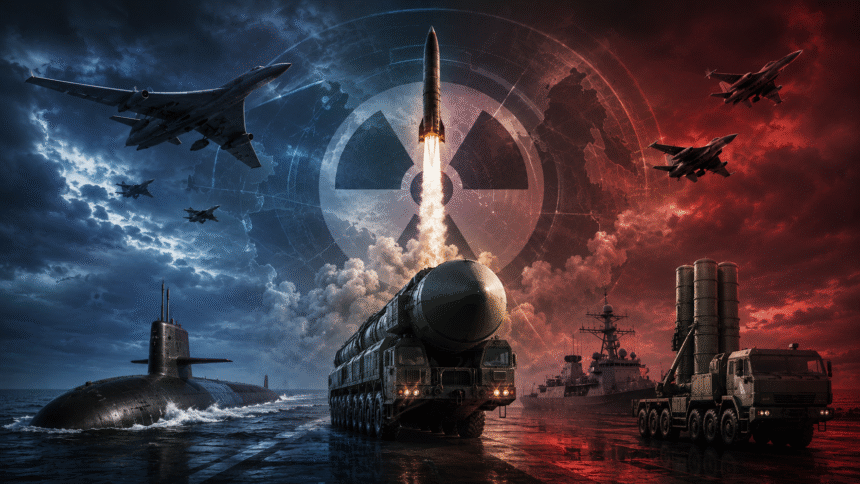
Russia has launched major exercises involving its nuclear forces, sending a direct signal of military readiness at a time when the war in Ukraine is increasingly shaped by drone strikes, long-range attacks, and rising tensions with NATO.
The drills come as Ukrainian drone operations have expanded deeper into Russian territory, targeting military logistics, energy infrastructure, and sites linked to Moscow’s war effort. Russian officials have framed the exercises as a test of strategic preparedness, while Western observers see them as part of a broader pressure campaign designed to remind Ukraine and its allies of Russia’s nuclear capabilities.
According to reports, the exercises are large in scale and involve tens of thousands of troops, missile systems, aircraft, warships, and submarines. The maneuvers are intended to test command structures, mobility, readiness, and coordination across Russia’s strategic forces. They also come alongside joint activity with Belarus, where Russia has deployed tactical nuclear weapons and strengthened military integration with Minsk.
The timing is significant. Ukraine has intensified its drone campaign against Russian targets, using unmanned systems to disrupt logistics, hit air-defense assets, and pressure oil facilities far from the front line. These strikes have forced Russia to defend a much wider area, creating a new challenge for Moscow as the war moves beyond traditional battlefield zones.
For the Kremlin, nuclear drills serve several purposes. Militarily, they test readiness and coordination among strategic units. Politically, they project strength to the Russian public and signal resolve to NATO. Strategically, they aim to warn Western governments against deeper involvement in Ukraine, especially as European states continue to provide Kyiv with military and technological support. NATO says its assistance is meant to help Ukraine defend itself against Russia’s war of aggression.
Belarus’s role adds another layer of concern. Minsk has hosted Russian tactical nuclear weapons and is now participating in drills linked to nuclear weapons use. Belarusian officials say the exercises are defensive and not directed at any third country, but critics argue that the deployment increases instability and turns Belarus into a more exposed military target.
The drills also revive concerns over Russia’s nuclear doctrine. In 2024, President Vladimir Putin approved changes lowering the threshold for possible nuclear response, including treating certain conventional attacks backed by a nuclear power as a potential joint threat. That shift has made every major escalation in the Ukraine war more sensitive, particularly when strikes, weapons supplies, and NATO support are involved.
Despite the dramatic nature of the exercises, analysts generally view them as signaling rather than preparation for immediate nuclear use. Russia has repeatedly used nuclear rhetoric during the war to shape Western calculations, discourage escalation, and reinforce the image that Moscow remains willing to defend its interests by all available means.
Still, the risk lies in miscalculation. As Ukrainian drones reach deeper into Russia and Moscow responds with military demonstrations, the line between conventional pressure and nuclear signaling becomes increasingly dangerous. The latest drills underline how the Ukraine war is no longer only a ground conflict. It is now a contest of drones, infrastructure strikes, psychological pressure, and strategic deterrence.
For Europe, the message is clear: the war’s risks are expanding. Russia’s nuclear exercises may be designed as a warning, but in an already volatile environment, every show of force adds pressure to a conflict with consequences far beyond Ukraine’s borders.