

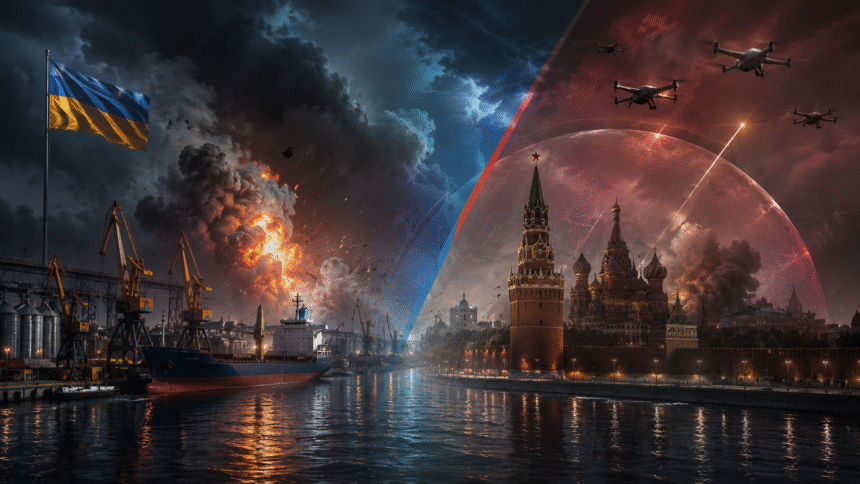
The war between Russia and Ukraine has entered another dangerous phase after a Russian air attack damaged port infrastructure in the Ukrainian city of Izmail, while Russian authorities said they intercepted Ukrainian drones heading toward Moscow. The exchange reflects a widening pattern of strikes beyond the front lines, with both sides increasingly targeting strategic infrastructure and symbolic locations.
Izmail, located in Ukraine’s southern Odesa region on the Danube River, is one of the country’s most important river ports. Since Russia’s full-scale invasion and the disruption of Black Sea export routes, Danube ports have become vital for Ukrainian trade, grain movement, and logistical connectivity with Europe. This makes Izmail not just a local target, but a strategic point in Ukraine’s economic survival and wartime supply network.
According to Ukrainian officials, the Russian strike caused damage to port infrastructure, though no major destruction or casualties were immediately reported. The attack fits into a broader Russian strategy of pressuring Ukraine’s transport, energy, and export systems, especially in regions that help Kyiv maintain access to international markets. Russian attacks were also reported in other Ukrainian regions, including Kharkiv, Dnipropetrovsk, Mykolaiv, and Zaporizhzhia.
At the same time, Moscow said its air defenses intercepted Ukrainian drones that were heading toward the Russian capital. The reported drone activity near Moscow comes after a series of Ukrainian strikes inside Russian territory, including attacks on border regions and industrial facilities. Reuters reported that recent Ukrainian drone attacks have killed people in Russia and targeted oil installations and facilities linked to Russia’s war effort.
The latest developments show how drones have become central to the war. Ukraine has increasingly used long-range and mid-range drones to pressure Russian logistics, air defenses, energy infrastructure, and military supply lines. These strikes are designed not only to cause physical damage but also to force Russia to spread its air defense systems across a much larger area.
For Russia, attacks on Ukrainian ports serve a different purpose: weakening Ukraine’s economy and disrupting export routes that connect the country to global markets. By targeting Danube infrastructure, Moscow is sending a message that even alternative trade corridors are vulnerable. Such attacks also raise concerns for nearby European states, especially Romania, which lies across the Danube from parts of Ukraine’s port network.
The escalation carries broader consequences for Europe. Any disruption to Ukrainian grain exports or river logistics can affect food supply chains, shipping insurance, and regional security calculations. It also increases pressure on European governments that continue to support Ukraine militarily and economically while trying to avoid a wider confrontation with Russia.
Diplomatic efforts remain stalled, with both Moscow and Kyiv accusing each other of escalating the conflict. Russia continues to deny deliberately targeting civilians, while Ukraine argues that strikes inside Russia are a response to Moscow’s continued attacks on Ukrainian cities and infrastructure. The result is a conflict that is no longer confined to trenches and battlefield zones but increasingly fought through drones, ports, energy sites, and long-range pressure campaigns.
The attack on Izmail and the drone activity near Moscow underline one clear reality: the Ukraine war is expanding in geography, technology, and strategic risk. As both sides deepen their reliance on air attacks and unmanned systems, the chances of wider regional consequences continue to grow.