


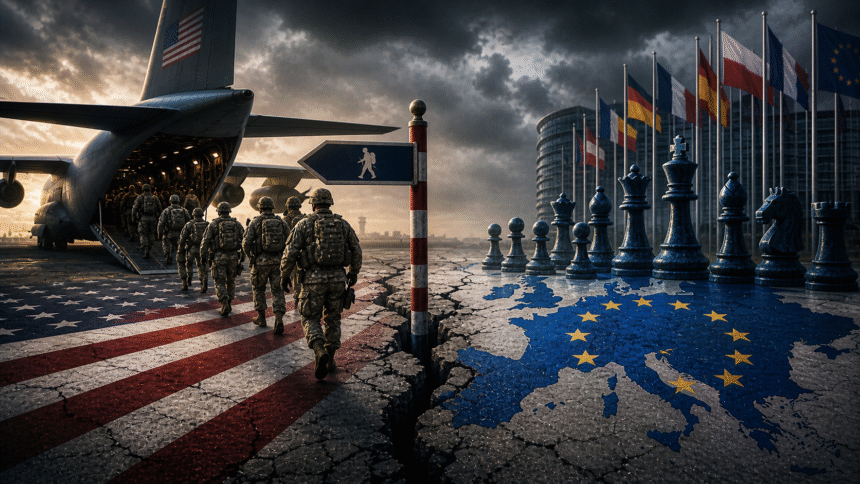
European leaders are growing increasingly concerned after U.S. President Donald Trump announced plans to reduce the American military presence in Germany. The decision has been seen across Europe as another warning sign that the continent can no longer assume permanent U.S. security guarantees and must take greater responsibility for its own defense.
The Pentagon announced that around 5,000 U.S. troops would be withdrawn from Germany, while Trump later suggested that the reduction could go even further. The move surprised NATO officials and raised questions about the future of America’s military footprint in Europe at a time when the continent is already facing pressure from Russia’s war in Ukraine and rising instability in the Middle East.
Germany remains one of the most important American military hubs in Europe. U.S. bases there support NATO operations, logistics, air defense, intelligence coordination, and rapid military deployment across the continent. For decades, the American presence in Germany has been a symbol of the transatlantic alliance and a key pillar of European security.
The planned withdrawal has therefore caused alarm not only in Berlin, but across Europe. Several European leaders interpreted the decision as proof that Washington’s priorities are shifting. They argue that Europe must increase defense spending, strengthen its own military capabilities, and reduce its dependence on American protection.
German Chancellor Friedrich Merz tried to downplay the dispute with Washington, saying differences with Trump should not damage the broader NATO alliance. However, the timing of the decision has added political tension, especially after disagreements between Berlin and Washington over Iran and the wider direction of U.S. foreign policy.
The withdrawal could also affect previous plans to deploy long-range U.S. missile systems in Germany. Reports indicate that the drawdown may cancel a Biden-era plan to station a battalion equipped with Tomahawk missiles, which Germany had supported as part of NATO’s deterrence posture against Russia.
For NATO, the decision creates uncertainty. The alliance is reportedly seeking more details from Washington about the scale, timeline, and strategic purpose of the troop reduction. European officials are concerned that sudden changes in U.S. deployments could weaken deterrence and complicate defense planning.
The issue also comes amid broader transatlantic friction. Trump has repeatedly demanded that European countries contribute more to their own defense, and his administration has also increased pressure on the EU over trade, including tariffs on European-made vehicles. For many European officials, the troop withdrawal is part of a wider pattern of U.S. pressure on Europe.
NATO Secretary General Mark Rutte said European countries have understood Trump’s message about burden-sharing, especially as Washington pushes allies to support U.S. strategic priorities. His comments reflected a growing recognition that Europe must prepare for a security environment in which American support may become less automatic.
The reaction in Europe has been clear: the continent needs a stronger defense posture. That means more investment in weapons production, air defense, intelligence, logistics, and rapid-response forces. It also means deeper cooperation between EU members, NATO allies, and non-EU partners such as Britain.
Still, replacing the American role will not be easy. The United States provides Europe with capabilities that many European militaries still lack, including strategic airlift, advanced missile systems, satellite intelligence, and large-scale command infrastructure. A sudden or poorly coordinated withdrawal could therefore create serious gaps.
The political message, however, may be even more important than the military one. Europe is now being forced to confront a difficult reality: its security future cannot depend entirely on decisions made in Washington. Whether the U.S. withdrawal from Germany remains limited or becomes the beginning of a broader drawdown, the debate has already changed.
In the end, Trump’s decision has intensified Europe’s push toward greater strategic independence. For European leaders, the lesson is direct: NATO remains essential, but Europe must be ready to defend itself with more money, more coordination, and more political will.