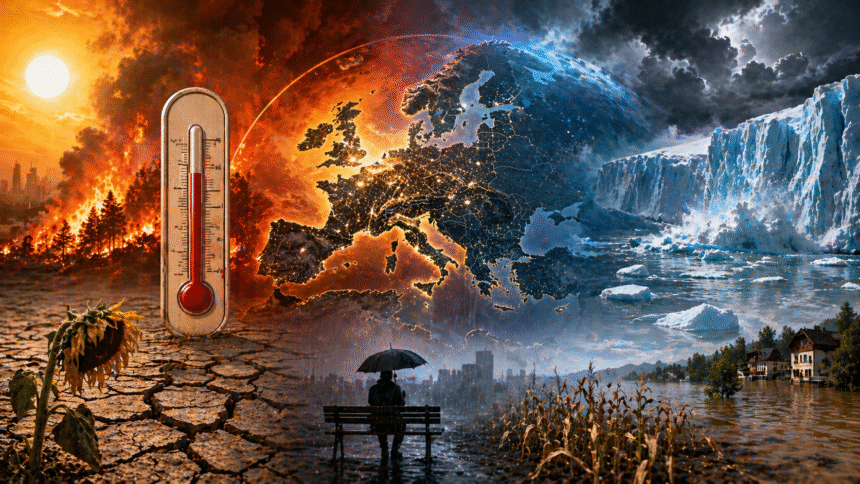
A new climate report has warned that Europe is now the world’s fastest-warming continent, with rising temperatures already reshaping daily life, public health, agriculture, energy systems and the wider economy.
The latest European State of the Climate 2025 report, produced by the World Meteorological Organization and the EU’s Copernicus Climate Change Service, found that Europe is warming more than twice as fast as the global average. Copernicus reported that the continent has warmed by around 0.56°C per decade over the last 30 years, making Europe one of the clearest global examples of accelerating climate change.
The report said that at least 95% of Europe experienced above-average annual temperatures in 2025. This means that extreme heat is no longer limited to southern Europe. Northern and sub-Arctic regions are also seeing dangerous temperature shifts, including a record three-week heatwave in northern Norway, Sweden and Finland, where temperatures near and inside the Arctic Circle exceeded 30°C.
These changes are already producing visible and costly effects. Heatwaves are becoming more intense, wildfires are burning larger areas, and drought conditions are putting pressure on water supplies and farming. Reuters reported that wildfires burned more than 1 million hectares in Europe in 2025, the highest annual total recorded, while May 2025 ranked among the driest periods for soil moisture since 1992.
The retreat of ice cover is another major warning sign. The WMO report said glaciers across all European regions recorded a net loss, with Iceland suffering its second-largest glacier loss on record. Snow cover was also 31% below average, while the Greenland Ice Sheet lost 139 gigatonnes of ice.
The consequences go far beyond the environment. For agriculture, hotter weather and drier soil can reduce crop yields, raise irrigation needs and increase food prices. For public health, longer heatwaves increase the risk of heat stress, especially among the elderly, outdoor workers and people with existing medical conditions. EUMETSAT noted that hospitals struggled during the 2025 Nordic heatwave, while dozens of drowning deaths were reported as people sought relief from extreme temperatures in open water.
The economy is also exposed. Heatwaves can reduce worker productivity, damage infrastructure, disrupt transport and increase electricity demand for cooling. At the same time, drought and wildfires can hurt tourism, agriculture, insurance markets and public budgets. In this sense, Europe’s climate crisis is not only a scientific warning; it is becoming an economic and social challenge.
The report also highlights the growing pressure on European governments. Many countries are trying to balance climate action with economic concerns, while some industries are pushing back against tougher environmental rules. But scientists warn that delaying action could make adaptation more expensive and the damage more difficult to contain.
Europe’s latest climate data sends a clear message: warming is no longer a distant threat. It is already affecting the continent from the Mediterranean to the Arctic Circle. The challenge now is whether European governments can move fast enough to protect people, food systems and economies from a climate reality that is arriving faster than expected.