

Economic confidence across the Eurozone declined sharply in April, adding to concerns that rising energy costs and war-related uncertainty are beginning to weigh heavily on European growth.
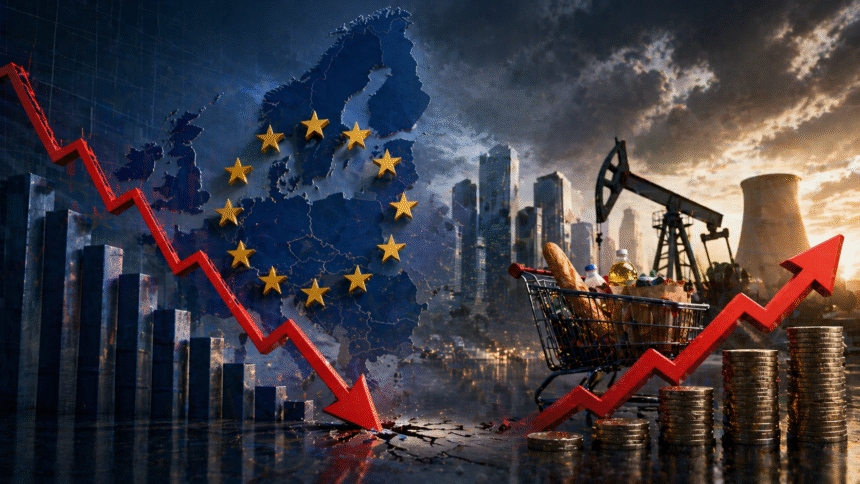
New European Commission data showed that the Economic Sentiment Indicator for the Eurozone fell to 93.0 in April, down from 96.6 in March, marking its weakest level in three and a half years. The decline reflects growing pessimism among consumers, retailers and service-sector companies as higher energy prices squeeze spending power and raise business costs.
The fall in confidence comes at a difficult moment for Europe. The war involving Iran has disrupted energy markets, pushed up fuel prices and renewed fears of supply shortages. For Eurozone countries, which are still recovering from the energy shock that followed Russia’s invasion of Ukraine, the latest pressure creates a familiar and dangerous pattern: weaker growth, higher costs and rising uncertainty.
The services sector was among the hardest hit, with confidence dropping to its lowest level in five years. This is significant because services are a major engine of the Eurozone economy, covering everything from travel and hospitality to retail, logistics and professional services. When confidence in this sector weakens, it often signals that consumers and businesses are preparing to spend less.
Consumers are also becoming more cautious. Concerns over household finances, major purchases and the general economic outlook have increased. Higher fuel and electricity prices reduce disposable income, forcing families to delay spending on non-essential goods and services. This directly affects retailers and small businesses, which depend heavily on steady consumer demand.
At the same time, price pressures are rising. Firms’ selling-price expectations increased, suggesting that companies may pass higher energy and production costs on to customers. Eurozone inflation is now expected to rise to around 2.9% in April, compared with 2.6% in March, mainly because of energy costs.
This creates a difficult policy dilemma for the European Central Bank. On one side, weaker confidence suggests the economy may need support. On the other side, rising inflation limits the ECB’s ability to cut interest rates. Reuters reported that the ECB is expected to keep rates unchanged at its upcoming meeting, but the debate over possible action later in the year is likely to intensify if inflation continues to accelerate.
Italy’s data showed a similar warning sign. Consumer confidence fell to 90.8 in April from 92.6 in March, while business morale also weakened. The decline was especially visible in services and construction, underlining how higher energy prices are already affecting the Eurozone’s third-largest economy.
The latest figures suggest that Europe is entering a more fragile economic phase. The problem is not only the immediate rise in energy prices, but the uncertainty created by a prolonged conflict. Businesses may delay investment, households may reduce spending, and banks may become more cautious in lending.
For Brussels and the ECB, the challenge is now to prevent a short-term energy shock from becoming a broader economic slowdown. Targeted support may help protect vulnerable sectors, but Europe’s deeper problem remains clear: as long as its economy remains exposed to external energy shocks, conflicts beyond its borders can quickly become domestic economic crises.
The message from April’s confidence data is simple: the Eurozone is not yet in crisis, but the warning lights are flashing. Rising energy costs, weaker confidence and inflation pressure are now moving together — and that combination could shape Europe’s economic outlook for the months ahead.