

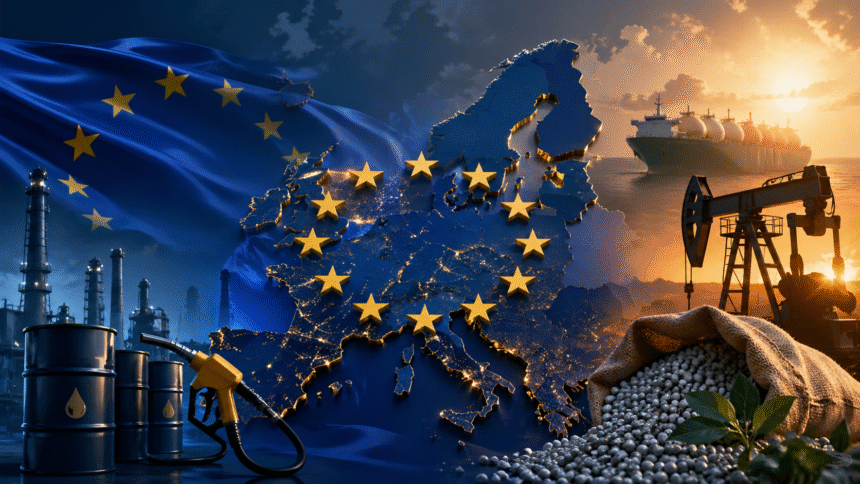
The European Union has moved to contain the economic shock caused by the ongoing war involving Iran, announcing temporary support measures for companies hit by rising fuel, electricity and fertilizer prices. The decision reflects growing concern in Brussels that the conflict is no longer only a Middle Eastern security crisis, but a direct economic threat to Europe’s industries, farms, transport networks and households.
Under the new temporary framework, EU member states will be allowed to provide greater state support to sectors most exposed to the price shock, including agriculture, fisheries, transport and energy-intensive industries. Companies in affected sectors may receive compensation for part of the increase in their fuel, fertilizer and electricity costs, with support targeted at businesses facing the heaviest burden.
The move comes as energy prices continue to rise amid fears over supply routes, especially after disruptions linked to the Strait of Hormuz. For Europe, the impact is particularly sensitive. The bloc is still recovering from the energy crisis triggered by Russia’s invasion of Ukraine in 2022, and policymakers are trying to avoid a repeat of the same inflationary pressure that weakened households and businesses across the continent.
European Commission President Ursula von der Leyen warned that the consequences of the war could last for months or even years. She also cautioned that Europe must avoid wasting billions on broad, poorly targeted subsidies, arguing that aid should go directly to the companies and sectors most affected by the crisis.
The Commission’s approach appears designed to balance two goals: protecting the European economy in the short term, while avoiding a return to large, open-ended fossil fuel subsidies. During the 2022 energy crisis, many European governments spent heavily to shield consumers and companies from soaring prices. This time, Brussels is pushing for more targeted support, partly to prevent richer member states from gaining an unfair advantage over smaller economies with less fiscal space.
Agriculture is one of the sectors most exposed to the crisis. Higher fuel prices increase the cost of machinery, transport and food distribution, while rising fertilizer prices directly affect farmers’ production costs. This could eventually feed into higher food prices for consumers, adding another layer of pressure to European inflation.
Transport companies are also under strain. Road hauliers, shipping operators and rail firms face higher operating costs at a time when supply chains remain fragile. Energy-intensive industries such as steel, chemicals and manufacturing are also vulnerable because electricity and fuel prices directly shape their competitiveness.
For Brussels, the crisis also strengthens the political argument for reducing Europe’s dependence on imported fossil fuels. Von der Leyen has repeatedly presented the energy transition not only as a climate policy, but as a matter of strategic security. The message from the Commission is clear: as long as Europe depends heavily on imported oil and gas, wars outside its borders can still shake its economy from within.
The temporary measures may help prevent business closures and soften the immediate shock, but they will not solve the deeper problem. Europe is facing a long-term test: how to protect its economy during global energy disruption while accelerating the shift toward cleaner, more secure sources of power.
In the short term, the EU is trying to buy time. In the long term, the Iran war may push Europe even faster toward energy independence.