

Germany’s inflation rate accelerated in April, rising to 2.9% year-on-year, as higher energy prices added fresh pressure on Europe’s largest economy. The increase marks another warning sign for policymakers as the continent faces the economic consequences of the Iran war and its impact on global energy markets.
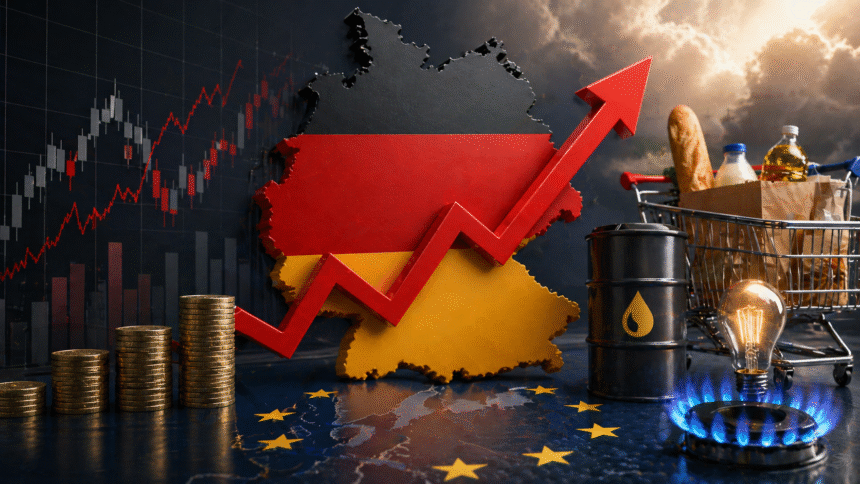
Preliminary data from Germany’s national statistics office showed that inflation moved up from 2.8% in March to 2.9% in April. The main driver was a sharp rise in energy prices, especially oil and natural gas, which increased by 10.1% year-on-year.
The rise comes at a sensitive moment for Germany. The country is still dealing with weak economic growth, cautious consumers and high production costs. For households, higher energy prices mean more expensive transport, heating and daily essentials. For businesses, they mean higher operating costs, especially in manufacturing, chemicals, logistics and heavy industry.
However, the data also carried one important signal: inflation has not yet spread deeply across the wider economy. Core inflation, which excludes volatile food and energy prices, fell from 2.5% in March to 2.3% in April. This suggests that, for now, the price shock remains mainly concentrated in energy rather than becoming a broader inflation wave.
Economists warned that this could change if the energy crisis continues. A prolonged conflict affecting oil and gas transport routes could force companies to pass higher costs on to consumers, creating what economists call “second-round effects.” In simple terms, this means today’s energy shock could become tomorrow’s general price increase.
The inflation data also increases pressure on the European Central Bank ahead of its upcoming policy meeting. The ECB is expected to keep interest rates unchanged for now, but the April figures may strengthen debate over whether further action will be needed later if inflation continues to rise.
Germany’s government has already adjusted its inflation outlook, expecting price growth to reach 2.7% in 2026 and 2.8% in 2027. That shows officials now expect the energy shock to last longer than initially hoped.
The wider eurozone is watching Germany closely because its economy often sets the tone for the rest of the bloc. If German inflation continues to rise, it could influence eurozone-wide inflation expectations and complicate the ECB’s path. The euro area’s April inflation release is also expected to show stronger price pressure, largely because of energy costs.
For Germany, the latest numbers reflect a difficult balance. Policymakers must protect households and businesses from rising energy costs without triggering excessive government spending or fueling inflation further. At the same time, the crisis may push Berlin and Brussels to accelerate efforts to reduce dependence on imported fossil fuels.
The message from the April inflation data is clear: Germany is not facing a full inflation crisis yet, but the warning signs are growing. As long as the Iran war continues to disturb energy markets, Europe’s largest economy will remain exposed to higher prices, weaker confidence and renewed pressure on monetary policy.