

France is pushing for tighter limits on Ukraine’s ability to use European Union-backed funding to purchase weapons and military components from outside Europe, opening a new debate over how the bloc should balance Kyiv’s urgent battlefield requirements with its ambition to strengthen its own defense industry.
The dispute centers on the EU’s €90 billion Ukraine Support Loan, designed to finance Ukraine during 2026 and 2027. Of that amount, an indicative €60 billion is dedicated to defense procurement and industrial capacity, while €30 billion is intended for broader economic and budgetary support.
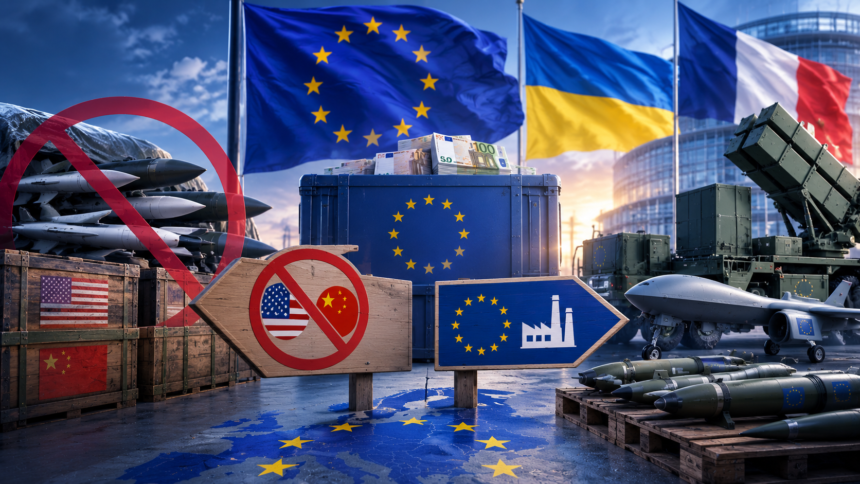
France is not proposing an immediate prohibition on non-European weapons. Instead, Paris wants to limit how long Ukraine can rely on exemptions that permit purchases outside Europe when European manufacturers cannot provide the necessary equipment quickly enough.
A “Buy European” Push
Under the loan’s procurement rules, European and Ukrainian defense industries receive priority.
Generally, no more than 35% of the value of a defense product can originate outside Ukraine, the EU and the European Economic Area under the relevant procurement conditions. However, exceptions can be granted when Ukraine has an urgent operational requirement that European or Ukrainian manufacturers cannot satisfy in sufficient quantities or within the necessary timeframe.
Those exceptions have already proved important.
Ukraine has received exemptions involving Chinese-made components used in drones and US-made Patriot interceptor missiles, which remain critical to protecting Ukrainian cities and infrastructure from Russian missile attacks.
The European Commission approved the exemptions after concluding that European production currently cannot fully satisfy Ukraine’s requirements in those areas.
France now wants such exemptions to remain temporary rather than becoming a long-term feature of the EU financing program.
Paris Wants European Money to Strengthen European Industry
France’s argument reflects a broader push for European strategic autonomy.
Paris believes that if European taxpayers are financing tens of billions of euros in military assistance, a substantial share of that spending should ultimately help expand European and Ukrainian defense manufacturing capacity, rather than permanently financing suppliers in the United States, China or other third countries.
France itself has one of Europe’s largest defense industries. The country is involved with Italy in producing the SAMP/T air-defense system, Europe’s closest existing alternative to the American Patriot system.
France and Ukraine have also recently expanded industrial cooperation. Paris has authorized licensed Ukrainian production of weapons including SCALP missiles and AASM bombs, while France and Italy plan to enable licensed production of Aster 30 air-defense missiles in Ukraine.
The French approach therefore combines military assistance to Ukraine with a longer-term effort to build a stronger European-Ukrainian defense industrial base.
Other European Countries Want More Flexibility
Not every EU government supports tighter restrictions.
In July, the defense ministers of Germany, the Netherlands, Sweden, Denmark, Estonia, Poland, Latvia, Finland and Lithuania called for Ukraine to retain maximum flexibility when purchasing urgently required equipment.
Their concern is straightforward: Ukraine is fighting an active war, and European factories cannot yet manufacture every weapon, missile or component Kyiv requires at the necessary speed and scale.
Restricting access to American or other foreign equipment too quickly could therefore create capability gaps.
The Patriot interceptor is an obvious example. Ukraine already operates the US-designed system and urgently requires additional missiles, while Europe currently lacks a directly interchangeable interceptor that could immediately replace those supplies.
How the French Proposal Could Work
The existing system already gives Brussels considerable control over exemptions.
When Ukraine requests funding for equipment covered by an exemption, the European Commission reviews the procurement arrangements. Exemptions must effectively be reconsidered when Kyiv requests new payments.
If a European manufacturer eventually becomes capable of providing equivalent equipment at the required price, volume and delivery schedule, Brussels could decline to continue the exemption and direct procurement toward the European supplier instead.
France wants this transition away from foreign suppliers to happen more systematically.
Rather than allowing exemptions to continue indefinitely, Paris is pushing for arrangements that would encourage Ukraine to switch toward European production as soon as credible alternatives become available.
Billions Already Moving Into Defense
The debate comes as the EU accelerates military financing for Ukraine.
On August 24, the European Commission approved another €6.1 billion in defense procurement covering air and missile defense systems, missiles, ammunition and radars.
That package followed previously approved procurement plans worth approximately €16 billion.
The scale of the funding means the procurement rules could have significant consequences for Europe’s defense industry.
Billions of euros spent on Ukrainian requirements could simultaneously finance new European factories, expand missile and ammunition production and reduce the continent’s long-term dependence on foreign weapons manufacturers.
A Difficult Balance for Brussels
The disagreement highlights a fundamental dilemma facing the European Union.
France argues that Europe’s massive financial commitment to Ukraine should also help build the industrial capacity required for Europe’s future security.
Other EU countries counter that Ukraine’s immediate military requirements must come first, particularly when European manufacturers cannot deliver the necessary weapons quickly enough.
Brussels therefore has to reconcile two objectives that do not always align: keeping weapons flowing to Ukraine today while creating a European defense industry capable of supplying those weapons tomorrow.
The outcome could reach far beyond the Ukraine Support Loan. How the EU handles these exemptions may influence future European defense programs, including the Security Action for Europe (SAFE) initiative and the European Defence Industry Programme.
For Ukraine, however, the immediate priority remains simpler: obtaining the weapons it needs without delays. For France, the challenge is ensuring that Europe’s response to that urgent demand also builds a defense industry capable of making the continent less dependent on foreign suppliers in the years ahead.