


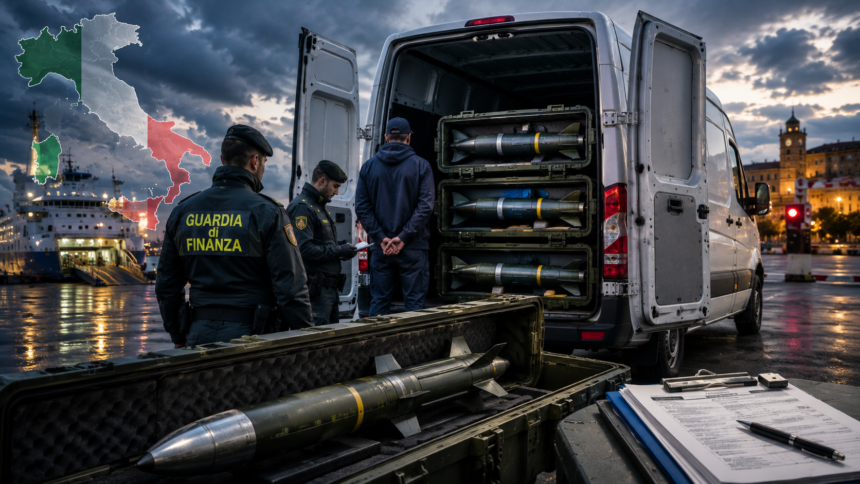
Italian authorities are investigating an unusual shipment of military equipment after three Akeron anti-tank missiles were discovered inside a French-registered van at the port of Bari, leading to the detention of its 46-year-old French driver.
The case, which emerged publicly this week, began with what authorities described as a routine inspection at the southern Italian port. The driver, identified in court documents as Regis Claude Albert Normand, had arrived aboard the Superfast II ferry from Patras, Greece.
Inside his vehicle, officers discovered five containers designed to transport anti-tank weapons systems.
One container was empty, another contained an inert training missile without a guidance system, propulsion or warhead, while the remaining three each contained an Akeron missile. Italian Army specialists subsequently assessed the three missiles as weapons of war based on the evidence available so far.
Routine Inspection Turns Into Military Investigation
The driver reportedly presented officers with three international consignment notes during the inspection.
Investigators, however, concluded that the documents were not sufficiently detailed to establish exactly what was being transported.
That prompted a more extensive examination of the cargo and ultimately the discovery of the missile systems.
The case was referred to the Bari judicial authorities, where preliminary investigations judge Valeria Isabella Valenzi ordered the driver to remain in pre-trial detention while investigators examine the shipment.
Italian state broadcaster Rai also reported that the missiles were discovered by the Guardia di Finanza following the vehicle’s arrival from Greece.
Suspicious Blue Markings Raise Questions
One of the most unusual elements of the investigation concerns markings found on the missile containers.
The tubes initially displayed blue bands.
Under NATO conventions, blue markings are generally associated with training equipment that does not contain active explosive components.
But Italian military specialists reportedly discovered that the blue markings were not original. Investigators said they appeared to consist of ordinary adhesive tape that could easily be removed.
After the blue tape was removed, investigators reportedly found yellow-and-black markings underneath.
According to the Italian Army’s assessment cited in court documents, those markings were consistent with high-explosive ammunition with a penetrating capability.
That discovery became a significant factor in authorities’ decision to treat the three Akeron missiles as military weapons rather than training equipment.
Driver Says the Missiles Were Being Transported for Repairs
Normand has denied that he was illegally moving weapons.
According to his account to investigators, he was working as a subcontracted driver involved in transporting military equipment connected to MBDA France, the European defense company that manufactures the Akeron missile family.
He said the equipment was connected to repair work involving Greek company Altus LSA. His lawyers presented commercial and travel documents as well as an authorization issued by the French Ministry of Defence to MBDA France in 2025 covering activities involving military equipment.
The existence of those documents, however, has not ended the investigation.
The Bari judge reportedly identified several issues requiring further examination, including discrepancies involving dates and stamps contained in the documentation.
Most importantly, according to the court findings reported by Italian and European media, the driver had not produced the Italian permits required for transporting military equipment through Italian territory.
Questions Over the Transport Company
Authorities are also examining the logistics arrangement behind the shipment.
Normand reportedly said he was operating as a subcontractor in a military transportation operation.
However, investigators found that the haulage company for which he works — reportedly registered in his wife’s name — did not appear to specialize in transporting military equipment.
That detail has attracted additional scrutiny because advanced missile systems normally require strict documentation, security procedures and authorization when crossing national borders.
The investigation therefore extends beyond the physical missiles themselves.
Authorities want to establish the complete chain of custody, including who authorized the shipment, where the missiles originated, their precise destination and whether their movement through Italy complied with national regulations.
What Is the Akeron Missile?
The Akeron family consists of advanced anti-tank and multipurpose guided missiles produced by European missile manufacturer MBDA.
The systems are designed for modern ground combat and can be used against armored vehicles and other hardened targets.
Their military nature explains why the discovery immediately triggered specialist examination by Italian Army personnel rather than being treated as an ordinary customs violation.
But the investigation does not itself establish that the missiles were intended for illicit military use.
The driver’s explanation that the equipment was connected to legitimate repair and maintenance work remains part of the case, and Italian authorities are still examining whether the shipment was fundamentally legitimate but improperly documented or whether more serious violations occurred.
Investigation Continues in Italy
The incident has attracted considerable attention across Europe because of the unusual circumstances surrounding the shipment: three operationally classified anti-tank missiles, questionable markings, disputed documentation and an apparently ordinary French-registered vehicle traveling through a civilian ferry terminal.
For now, however, several crucial questions remain unanswered.
Italian investigators must determine whether the missiles were legally being transported on behalf of defense contractors, why the required Italian authorizations were apparently unavailable, and why the missile containers carried blue markings associated with training equipment.
Until those questions are resolved, the case remains an active judicial investigation rather than evidence of an illegal weapons-smuggling operation.
What began as a routine inspection at the Port of Bari has therefore developed into a cross-border investigation involving French defense logistics, Greek maintenance operations and Italian weapons-transport regulations — with the precise circumstances surrounding the three Akeron missiles still under scrutiny.