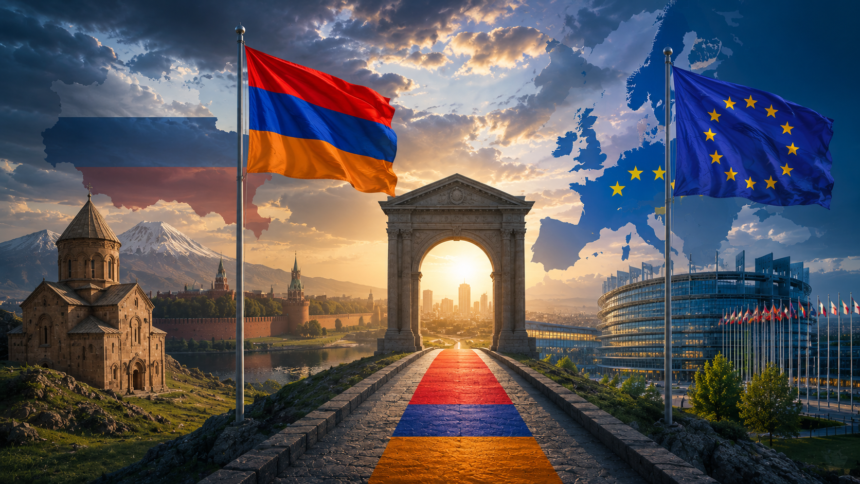
Armenia is preparing to take one of the most consequential foreign-policy steps in its post-Soviet history, with Prime Minister Nikol Pashinyan announcing that Yerevan expects to begin the process of formally applying for membership in the European Union “in the near future.”
Speaking in parliament on August 24 while presenting his government’s program for 2026–2031, Pashinyan said Armenia must first submit an official application to Brussels before determining a roadmap toward possible accession and eventually asking Armenian voters to decide the country’s European future in a national referendum.
The announcement represents a significant geopolitical shift for a country that has historically maintained exceptionally close political, economic and security ties with Russia.
Armenia Is Preparing to Knock on the EU’s Door
Pashinyan made clear that Armenia has not yet formally applied for EU membership.
Instead, his government is preparing the groundwork necessary to submit an application.
The sequence envisioned by Yerevan would begin with a formal membership request. Armenia would then wait for Brussels’ response and seek greater clarity over the reforms, conditions and possible timetable associated with accession. Only after those steps would the government consider putting membership to a nationwide referendum.
This distinction is important because Armenia currently has neither EU candidate status nor any guarantee that an application would ultimately result in membership.
The European Commission responded cautiously but positively to the announcement, saying Armenia is now “closer to the EU than ever” while emphasizing that accession remains a formal, merit-based process.
The Shift Did Not Begin Overnight
Armenia’s European turn has been developing for several years.
In March 2025, the Armenian parliament approved legislation formally launching a process aimed at eventual EU accession. The law expressed Armenia’s political aspiration to move toward membership but did not itself constitute an application to join the bloc.
Relations with Brussels have accelerated further during 2026.
European Commission President Ursula von der Leyen visited Yerevan in July and announced new economic and political support measures, including trade initiatives intended to help Armenia diversify its exports and withstand economic pressure from Russia.
Public opinion also provides Pashinyan with some political room to pursue closer European integration. An EU-commissioned 2026 survey found that 63% of Armenians surveyed who were aware of the EU supported accession, although respondents also expressed concerns about the potential impact on relations with Russia.
Russia Is the Central Question
Armenia’s potential EU application carries particular geopolitical significance because the country remains a member of the Eurasian Economic Union, the Russia-led economic bloc that also includes Belarus, Kazakhstan and Kyrgyzstan.
Pashinyan himself has acknowledged that simultaneous membership in both the EU and EAEU would ultimately be impossible.
That means Armenia could eventually face a strategic choice between the two economic systems.
Russia, Belarus, Kazakhstan and Kyrgyzstan called in May for Armenia to hold a referendum on whether it intends to remain within the Eurasian bloc or pursue European Union membership.
Pashinyan has rejected the idea of holding such a vote immediately.
His argument is that Armenians cannot meaningfully choose EU membership before knowing whether Brussels is prepared to advance Armenia’s application and what the conditions of accession would actually involve.
Why Armenia Is Moving Away From Moscow
The transformation in Armenian foreign policy has deeper roots than the current membership debate.
For decades, Armenia relied heavily on Russia for security while maintaining close economic ties with Moscow.
But confidence in that relationship deteriorated dramatically following the conflicts involving Armenia and Azerbaijan over Nagorno-Karabakh and Armenia’s growing dissatisfaction with the effectiveness of Russia-led regional security arrangements.
Yerevan subsequently began diversifying its diplomatic and security partnerships and expanding cooperation with Europe and the United States.
Pashinyan has increasingly framed this strategy around Armenian sovereignty rather than simply choosing between Russia and the West.
Armenia nevertheless remains economically intertwined with Russia, particularly through trade, energy and the Eurasian Economic Union. That dependence means any rapid geopolitical realignment could carry significant economic costs.
Brussels Is Moving Closer to Yerevan
Europe has responded to Armenia’s shift with increasingly visible political and economic engagement.
During her July visit to Yerevan, von der Leyen announced measures aimed at expanding Armenian access to European markets and supporting sectors affected by Russian trade restrictions.
The EU has also been supporting Armenian reforms involving justice, policing, anti-corruption measures and democratic institutions while promoting investment in energy, transport, digital infrastructure and other sectors.
That does not mean EU membership is imminent.
Even after Armenia submits an application, the European Commission would have to assess it and EU member states would have to agree before Armenia could receive candidate status. Accession negotiations themselves could then take years and require extensive legal, political and economic reforms.
A Geopolitical Shift in the South Caucasus
Armenia’s move also carries implications beyond its borders.
The South Caucasus has historically been an arena where Russia exercised significant political and security influence. A formal Armenian application to join the EU would therefore mark another expansion of European political ambitions into a region once considered firmly within Moscow’s sphere.
For Brussels, Armenia could become an increasingly important partner connecting Europe with the Caucasus and potentially Central Asia.
For Moscow, however, Armenia’s trajectory raises the prospect of losing influence over one of Russia’s historically closest regional partners.
And for Yerevan, the challenge will be managing that transition without triggering economic or security consequences that Armenia is unprepared to absorb.
A Historic Decision Still Lies Ahead
Pashinyan’s announcement does not mean Armenia is joining the European Union tomorrow.
But it changes the political question.
The debate is increasingly moving away from whether Armenia should explore closer relations with Europe and toward how far that integration should ultimately go.
Submitting an official membership application would transform Armenia’s European ambitions from a political declaration into a formal diplomatic process.
The eventual decision, Pashinyan says, would belong to Armenian citizens through a referendum.
If that process ultimately results in Armenia choosing the European Union, it would represent not simply another enlargement of the bloc, but one of the most significant geopolitical realignments in the South Caucasus since the collapse of the Soviet Union.