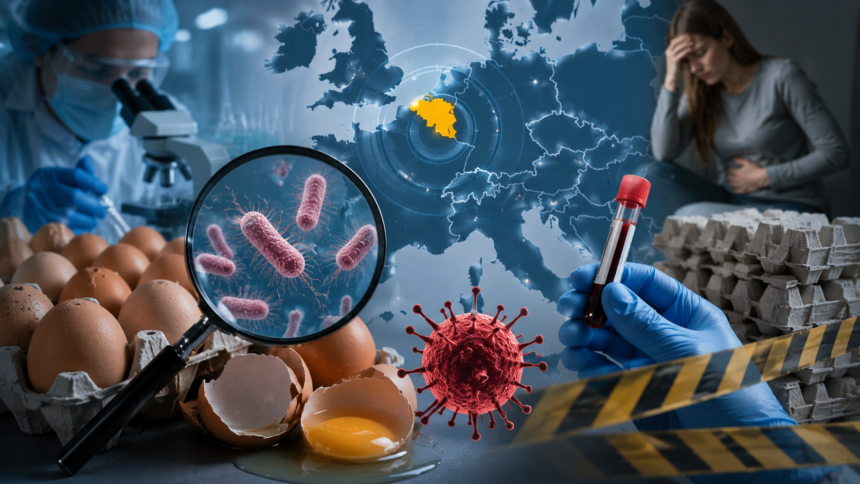
Belgium is dealing with its largest recorded salmonella outbreak, with at least 306 confirmed infections linked to contaminated eggs from a poultry farm in the country’s northern region, prompting recalls that have extended beyond Belgium into several other European countries.
Belgium’s Federal Agency for the Safety of the Food Chain (FASFC/AFSCA) said laboratory analysis connected people who became ill with the same strain of salmonella detected at the affected farm. Authorities warn that the true number of infections could be higher because people experiencing mild or no symptoms may never have been tested.
No deaths associated with the Belgian outbreak have been reported so far.
Contaminated Eggs Traced to a Farm in Geel
Investigators traced the outbreak to eggs produced by Laerco BV, based in Geel in northern Belgium.
Salmonella contamination was initially detected at the facility in late April, prompting authorities to launch a major recall in May.
At first, investigators believed the contamination was restricted to one of the farm’s four poultry houses. Restrictions were imposed on that section of the operation, but infections continued to appear at a higher rate than authorities expected.
Further laboratory testing subsequently detected salmonella in a second poultry house. Belgian authorities then expanded their response, blocking the entire facility and organizing another recall.
The entire farm was eventually closed, and the poultry were culled following a second recall on August 10.
Up to Two Million Eggs Potentially Affected
The scale of the distribution has increased concern among food-safety officials.
According to Belgian authorities, as many as two million potentially contaminated eggs were sold in Belgium and neighboring Luxembourg. Officials have warned that some of those eggs could still be stored in consumers’ homes despite the recalls.
The affected eggs were distributed through major supermarket networks, including retailers such as Aldi, Carrefour, Colruyt and Delhaize.
The recalled eggs can be identified by four codes printed directly on their shells:
2-BE-1073-01
2-BE-1073-02
2-BE-1073-03
2-BE-1073-04
Belgian consumer organizations and retailers have advised customers who still have eggs carrying these codes not to consume them and to return them to the retailer.
Recall Expands Beyond Belgium
The incident has developed into a wider European food-safety issue because the affected supply chain extended beyond Belgium.
FASFC says precautionary recalls have been initiated in eight other European countries, with authorities identifying countries including the Netherlands, France, Italy and Portugal among those potentially affected. Luxembourg has also recalled eggs associated with the producer.
Food Safety News reported that European food-safety notifications also identified distribution to the Czech Republic, Poland and Spain.
The cross-border distribution demonstrates how contamination at a single agricultural facility can rapidly become a multinational food-safety problem because of Europe’s integrated food supply chains.
Why Authorities Are Concerned
Salmonella is one of the most common causes of foodborne illness and is frequently associated with eggs and poultry.
The Belgian outbreak involves Salmonella Enteritidis, a strain strongly associated with eggs.
Typical symptoms include diarrhea, fever, abdominal cramps, nausea and vomiting. Symptoms often appear within hours or several days after consuming contaminated food.
Most healthy people recover without specialized treatment, but infection can become more serious for young children, elderly people and individuals with weakened immune systems.
Authorities have stressed that the 306 confirmed cases may underestimate the outbreak’s actual scale.
Some infected people may experience only mild illness and never visit a doctor, while others can carry the bacteria without noticeable symptoms. This makes it difficult to establish the complete number of people exposed.
Cases Stretch Back More Than a Year
Evidence suggests the cluster has a longer history than the latest recalls might indicate.
Food Safety News reported earlier this month that patients connected to the outbreak ranged in age from under one year to 96 years, with recorded illnesses stretching from February 2025 through July 2026.
Investigators used laboratory testing, including whole-genome sequencing, to compare salmonella samples taken from patients with samples found at the poultry facility.
That analysis helped establish the connection between the human infections and the contaminated eggs.
The number of confirmed cases may also continue to change because laboratory analysis and epidemiological tracing can take several weeks.
Belgium Faces an Unprecedented Cluster
Salmonella infections themselves are not unusual in Belgium.
What makes the current outbreak exceptional is its scale.
A spokesperson for Belgium’s food-safety agency told Reuters that while salmonella occurs relatively regularly, authorities had never previously encountered such a broad cluster affecting so many people.
The investigation is therefore focused not only on removing potentially contaminated products but also on understanding how the bacteria spread beyond the section of the farm initially identified as the source.
The discovery of contamination in a second poultry house was particularly significant because it demonstrated that the original containment measures had not completely eliminated the problem.
European Food-Safety Systems Under Scrutiny
The Belgian outbreak is also becoming a test of Europe’s ability to trace contaminated food across national borders.
Modern European agricultural supply chains allow eggs and other products produced in one country to reach supermarkets across multiple markets rapidly. That provides consumers with efficient access to food but can significantly widen the consequences when contamination occurs.
Belgian authorities have now closed the affected facility, recalled potentially contaminated products and alerted other European countries.
The immediate priority is ensuring that recalled eggs no longer remain in households or commercial supply chains.
But with 306 confirmed infections, potentially two million eggs involved and recalls extending across Europe, the Belgian outbreak has already developed from a localized contamination incident into one of Europe’s most significant food-safety stories of the summer.