

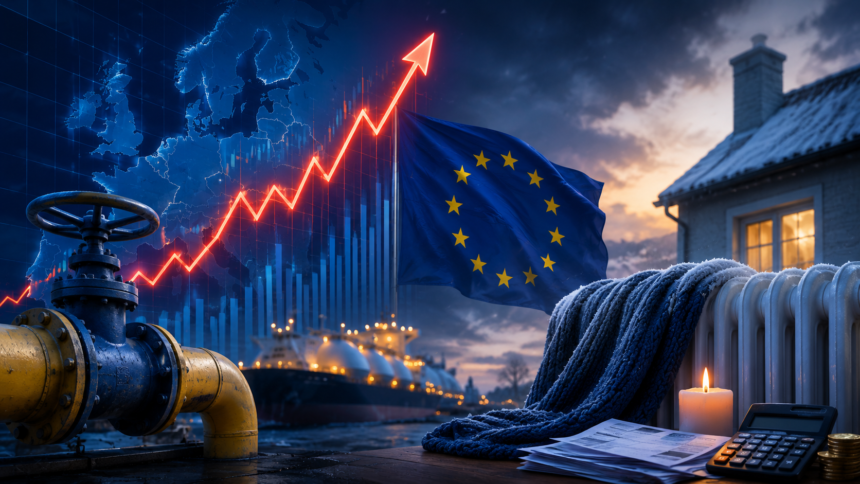
Europe is heading toward the winter heating season under renewed energy pressure, as wholesale natural gas prices climb to their highest levels in more than three years and unusually low storage levels raise concerns about both supply security and household energy bills.
The Dutch TTF, Europe’s main benchmark for natural gas, has recently traded above €65 per megawatt-hour, more than double its level at the beginning of 2026. During the past week, TTF futures reached a settlement high of €65.86/MWh — their highest level since January 2023.
The increase has revived memories of Europe’s 2022 energy crisis, although prices remain well below the extraordinary peaks reached during that period.
Why Are Gas Prices Rising?
Several pressures are converging at the same time.
One of the biggest is continued disruption to global liquefied natural gas supplies associated with the conflict in the Middle East and restrictions affecting shipping through the Strait of Hormuz, a route normally used for roughly one-fifth of global LNG trade. European LNG prices have consequently risen to their highest level since early 2023.
Europe has become increasingly dependent on LNG since reducing its reliance on Russian pipeline gas. That means European buyers must compete with Asian economies for internationally traded cargoes whenever supplies become tight.
An exceptionally hot European summer has added another complication. High temperatures increased electricity consumption for air conditioning, while drought and heat reduced output from some hydroelectric and nuclear facilities. Utilities consequently burned additional gas to generate electricity — gas that might otherwise have been placed into storage for winter.
Europe’s Gas Storage Is Behind Schedule
The condition of Europe’s storage facilities is becoming one of the biggest concerns ahead of winter.
EU storage was approximately 63% full on August 24, compared with a five-year average of around 79% at the same point of the year.
Some major gas markets are considerably more exposed. Dutch storage facilities, for example, were only around 44% full on August 23, prompting Gasunie to warn that the Netherlands is unlikely to reach its national winter storage target without additional measures.
Lower inventories do not necessarily mean Europe will experience shortages. Gas consumption has declined substantially since the previous energy crisis, renewable generation has expanded and Europe has built greater capacity to import LNG.
But low storage leaves the continent with a smaller safety cushion if winter temperatures become unusually cold or another major supply disruption occurs.
Household Bills Could Be Next
For European consumers, the crucial question is how quickly higher wholesale prices reach household bills.
The answer varies considerably between countries because governments and energy suppliers use different pricing systems and contract structures. Consumers in markets where retail prices respond quickly to wholesale movements could feel the impact relatively soon, while households protected by longer-term contracts may experience the increase several months later.
Higher gas prices can also push electricity bills upward because gas-fired power stations frequently determine wholesale electricity prices in European markets.
Recent data already show this effect. Average wholesale electricity prices exceeded €110/MWh across major European markets last week, with analysts attributing part of the increase to higher gas prices.
Britain Offers an Early Warning
The impact is already becoming visible in Britain.
Energy regulator Ofgem announced on Wednesday that its household energy price cap will increase by about 4% from October, taking the typical annual dual-fuel bill to around £1,723, its highest level in three years. Higher wholesale gas costs were a major contributor to the increase.
Further increases could follow if wholesale prices remain elevated through the autumn and winter.
Europe’s Winter Energy Test
Europe is in a stronger position than it was during the immediate aftermath of Russia’s invasion of Ukraine. Governments have diversified suppliers, expanded LNG infrastructure, reduced consumption and accelerated renewable-energy investment.
But the latest price surge demonstrates that Europe’s energy system remains vulnerable to geopolitical shocks far beyond its borders.
The coming months will therefore depend heavily on three factors: winter temperatures, Europe’s ability to rebuild gas inventories, and the availability of LNG on global markets.
A mild winter and improved supplies could quickly ease the pressure. But a prolonged cold spell combined with continued disruption to global LNG shipments could force European countries to compete aggressively for additional gas.
For millions of households, the consequences would ultimately appear in the most visible place: their winter energy bills.