


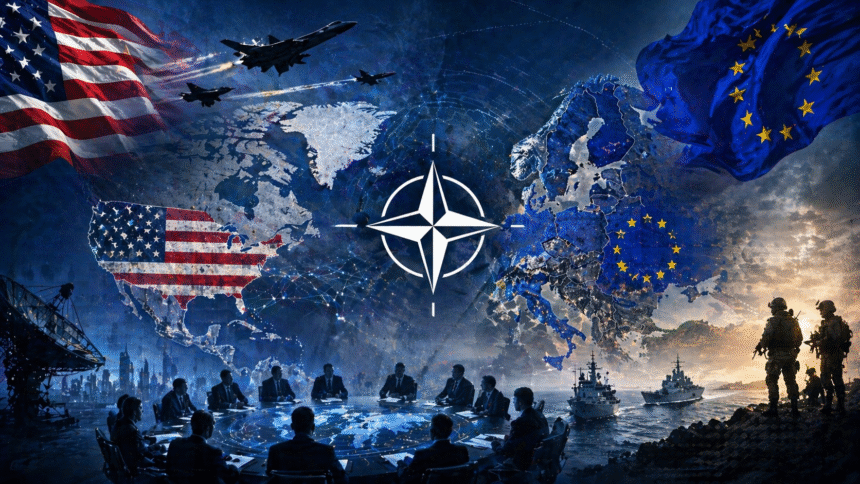
The NATO alliance is intensifying internal discussions to reassess its strategic posture, as questions grow over the future scope of the United States’ role in European and transatlantic security.
Senior officials within NATO are increasingly focused on developing alternative security scenarios that account for potential shifts in U.S. engagement. While Washington remains the alliance’s most influential military power, evolving political dynamics have prompted European members to consider how they would respond to a reduced or redefined American presence.
These discussions are not about replacing the United States, but rather about ensuring that the alliance can remain effective under a wider range of strategic conditions.
A key element of the debate centers on Europe’s ability to shoulder greater responsibility for its own defense. NATO members are examining gaps in military readiness, logistics, intelligence, and rapid deployment capabilities, with an emphasis on strengthening European contributions within the alliance.
Several countries have already increased defense spending and accelerated modernization programs, reflecting a broader shift toward enhancing operational autonomy.
The United States continues to play a central role in NATO’s deterrence strategy, particularly through its military presence in Europe and its leadership in intelligence and advanced defense systems. However, political debates within the U.S. about overseas commitments have introduced a degree of uncertainty about long-term engagement.
This uncertainty is driving NATO planners to prepare for multiple scenarios, ranging from sustained U.S. leadership to a more limited or selective role.
NATO’s evolving approach underscores the importance of flexibility in an increasingly unpredictable global environment. By exploring different security models, the alliance aims to reduce vulnerabilities and maintain cohesion even under changing geopolitical conditions.
At the same time, officials stress that unity remains the alliance’s strongest asset, and that any adjustments are intended to reinforce—not weaken—the transatlantic partnership.
The current moment represents a significant test for NATO’s adaptability. As global power dynamics shift and new security challenges emerge, the alliance’s ability to recalibrate its strategy will be critical.
Whether these discussions lead to structural changes or simply greater preparedness, one thing is clear: NATO is entering a phase of strategic reassessment that could shape its future for years to come.