


In the heart of Madrid, the Real Jardín Botánico (Royal Botanical Garden) stands as a harmonious fusion of art, science, and nature, lying beside the world-famous Museo del Prado. Established in the late 18th century under the patronage of King Charles III, the garden was designed by architects Francesco Sabatini and Juan de Villanueva as part of a grand vision to combine scientific research with artistic heritage.
A Garden Born from Enlightenment Vision
Initially conceived as a companion to the planned museum of natural sciences, which later became the Prado Museum, the garden became a repository for botanical treasures from Spain’s colonies. Today, visitors who enter through the elegant Puerta de Murillo can still trace the original geometric layout, structured in four main terraces descending gently toward the Paseo del Prado.
Over time, the 20-acre garden has evolved, incorporating modern additions such as a Japanese garden and an archway with 400 grape varieties—a nod to Spain’s viticultural traditions. Amid Madrid’s scorching summers, its carefully irrigated avenues provide a refreshing sanctuary of light, shade, and biodiversity.
Trees That Tell Centuries of Stories
Guided by director María-Paz Martín, whose expertise lies in mycology (the study of fungi), visitors can explore centuries-old trees like the towering evergreen cypress and the resilient Zelkova carpinifolia, native to dry regions of eastern Europe and Asia. These trees illustrate how life flourishes even under the city’s intense heat.
The garden’s flora bridges continents and histories: Judas trees bloom in rose-purple each spring, Golden Rain trees thrive in the summer sun, and a remarkable Swamp Cypress—misleadingly named—proves capable of thriving far from wetlands. Another standout is a weeping jasmine, a graceful reminder of the species introduced to Spain by the Moors centuries ago.
Linking Art and Botany
Earlier this year, the nearby Prado Museum hosted an exhibition titled “A Botanical Stroll Through the Prado,” which highlighted the presence of flowers and plants in masterpieces that often escape viewers’ notice. Among the exhibits was a portrait of the young Charles III holding a six-petaled white jasmine—an artistic foreshadowing of his future role in establishing the botanical garden.
Dahlias: Madrid’s Floral Legacy
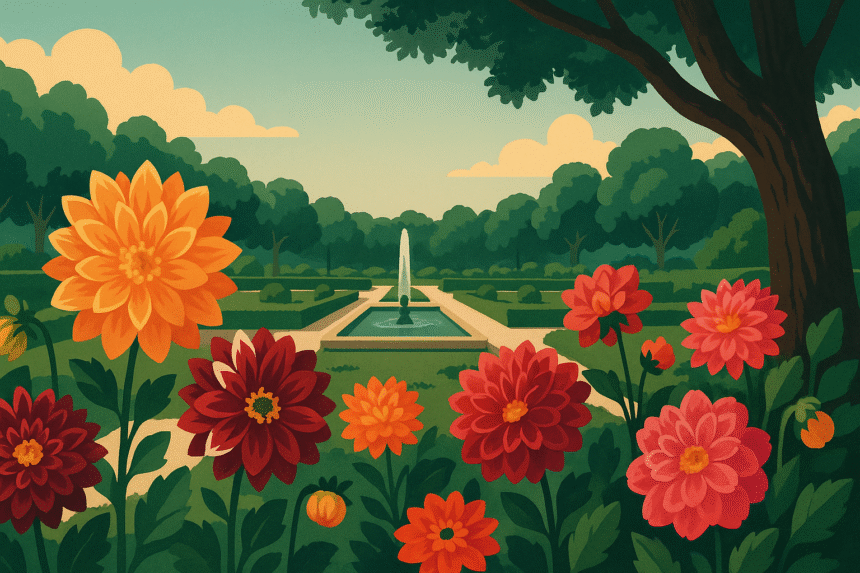
Down the garden’s terraces, vivid beds of dahlias—flowers with deep historical ties to Madrid—capture the attention of visitors. These blooms, native to Mexico, were first brought to Spain in the 18th century. Among the radiant varieties are Bohemian Spartacus (deep red), Noel (red-and-white flecked), and Dark Fubuki (rich purple-crimson), all flourishing under the Spanish sun.
Director Martín points to a wild dahlia (Dahlia pinnata) as a living reminder of the plant’s origins in Mexico. In the garden’s archive, archivist Esther García Guillén preserves historical documents from the late 18th century that trace the earliest European encounters with dahlias. These records, sent by plant collectors from Mexico to Spain’s celebrated botanist Antonio Cavanilles, include watercolours and handwritten notes that mark the first European description of the dahlia—then mistakenly classified as Coreopsis.
The Birthplace of Dahlia Cultivation
The archival drawings, dated 1789, depict delicate single dahlias with pale pink-purple petals and seed heads identical to modern varieties. These are the earliest known visual and written records of the flower that would later captivate gardeners across Europe. Within decades, horticulturists transformed the simple wild dahlia into the lavish hybrids we know today—from pom-pom forms to dinner-plate blooms.
A Garden That Inspires Emotion
Though the Prado’s paintings by Velázquez, Titian, and Murillo stir deep artistic emotion, for many visitors it is the living art of the Jardín Botánico that evokes the strongest response. Standing before the first recorded image of a dahlia—a plant that journeyed from the Americas to Europe and bloomed into a global favorite—one can understand why this garden, with its living history and delicate beauty, moves visitors to tears.
Madrid’s Jardín Botánico remains not just a garden but a dialogue between art, science, and time—where the story of the dahlia still blossoms, centuries after its first arrival from the New World.