

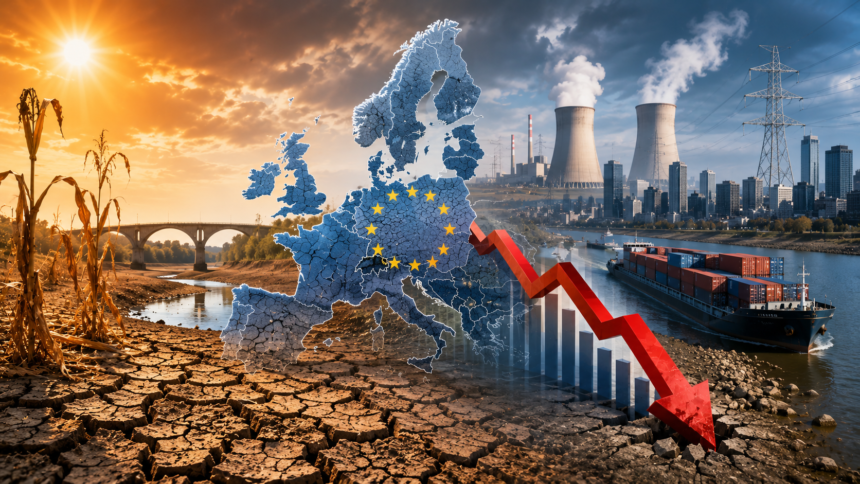
Extreme heat and prolonged drought across Europe could erase a substantial share of the European Union’s expected economic growth this year, as increasingly severe weather disrupts workers, agriculture, energy production and transportation networks.
A new assessment from Dutch bank Triodos estimates that climate-related disruption could reduce EU gross domestic product by around 1% in 2026, equivalent to approximately €180 billion ($208 billion) in lost economic output. The estimate illustrates how extreme weather is evolving from an environmental problem into a significant economic risk for Europe.
One of the largest economic effects comes from declining labor productivity. Extreme temperatures make outdoor work more difficult in industries including construction, agriculture and transportation, while excessive heat can also reduce productivity in factories, offices and other workplaces without adequate cooling.
Agriculture is another major source of pressure. Persistent drought and unusually high temperatures have damaged crops and reduced yields in parts of Europe. Separate reporting on the economic impact of this summer’s climate conditions indicates that some crop yields have fallen by around 6% to 7%, creating additional pressure on farmers and potentially contributing to higher food prices.
Europe’s energy sector is also vulnerable. Low river levels and unusually warm water have affected electricity generation, including nuclear plants that depend on rivers for cooling. Hydroelectric production can also suffer when reservoirs and waterways fall, potentially increasing reliance on more expensive alternative sources of electricity.
Transportation has emerged as another economic weak point. Falling water levels on major commercial waterways such as the Rhine and Danube have disrupted shipping, forcing vessels to reduce cargo loads or suspending some operations. In Germany alone, disruption to Rhine shipping could reduce economic growth by around 0.3 percentage points, according to estimates cited by Reuters.
Southern European economies face additional risks from wildfires and extreme temperatures. Spain, France, Italy and Greece have confronted severe heat and fire conditions, creating costs for emergency services and infrastructure while threatening agricultural production and tourism-dependent communities.
The economic consequences may also extend beyond the immediate summer months. Lower agricultural output can increase food prices, disrupted transportation can raise costs for manufacturers, and governments may face larger bills for disaster response, infrastructure repairs and long-term climate adaptation.
The Triodos estimate therefore adds to growing evidence that extreme weather is becoming a macroeconomic challenge for Europe rather than simply a seasonal disruption. With heatwaves, drought and wildfires simultaneously affecting multiple sectors, climate conditions could increasingly influence inflation, government spending, investment and the broader trajectory of European economic growth.