

Europe’s prolonged drought is pushing major rivers to exceptionally low levels, intensifying pressure on transportation, agriculture and electricity production across Central and Southeastern Europe as weeks of extreme heat continue to strain the continent’s water resources.
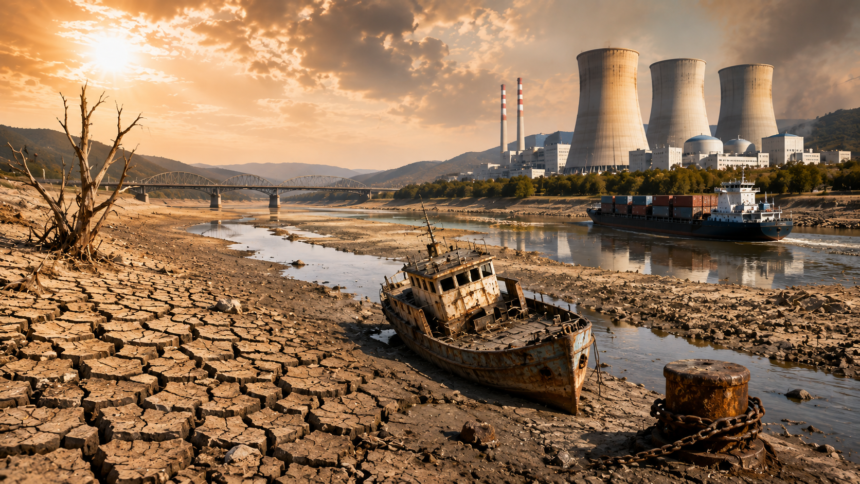
The Danube, one of Europe’s most important commercial waterways, has been particularly affected. Record-low water levels have disrupted shipping and created serious problems for power stations that depend on river water for cooling, while similar conditions have affected waterways elsewhere in Europe.
Hungary has emerged as one of the clearest examples of the growing link between drought and energy security. Falling Danube levels forced the Paks nuclear power plant, Hungary’s only nuclear station and a facility responsible for nearly half of the country’s electricity, to drastically reduce production because insufficient river water was available for cooling.
At the height of the crisis, Paks was operating at only around 10% of capacity, with just one of its eight turbines running. Hungarian authorities had warned that conditions could force the facility into a complete shutdown if the Danube continued falling.
There has been some improvement. By August 10, the Danube had risen by about 19 centimeters near Paks, allowing operators to begin bringing a second turbine back online. However, Hungarian officials cautioned that the recovery could be temporary and that the underlying drought remains a serious threat.
The problems extend beyond Hungary. Romania has also faced pressure on electricity generation as low Danube levels affect nuclear and hydropower operations, contributing to concerns over energy supplies across Southeast Europe. Governments in the region have been considering measures to conserve electricity and protect their grids as the drought continues.
River transportation is another casualty of the crisis. Lower water levels mean cargo vessels must reduce their loads to avoid running aground, decreasing the amount of fuel, grain, industrial materials and other goods that can be transported economically along Europe’s waterways. The disruption can force companies to rely more heavily on rail and road transportation, increasing logistics costs.
Agriculture is simultaneously struggling with depleted soil moisture, reduced irrigation supplies and prolonged heat. Farmers across drought-affected areas face growing pressure on crops and livestock, while shortages of water are forcing authorities to reconsider how increasingly scarce supplies should be allocated between households, farming, industry and energy production.
The Rhine has also experienced unusually low levels, demonstrating that the problem stretches beyond the Balkans. From Central Europe toward the Black Sea, shrinking waterways are exposing sandbanks and riverbeds while creating economic consequences for industries that depend on reliable river transport and water supplies.
The crisis is increasingly raising questions about Europe’s ability to adapt critical infrastructure to more frequent periods of extreme heat and drought. Nuclear plants, hydroelectric facilities, agriculture and inland shipping all depend heavily on predictable water availability, making prolonged drought a broader economic and energy-security challenge rather than simply an environmental emergency.
Although rainfall could provide temporary relief, current conditions demonstrate how rapidly severe drought can ripple through interconnected European economies, affecting everything from food production and electricity supplies to industrial logistics and international trade.