

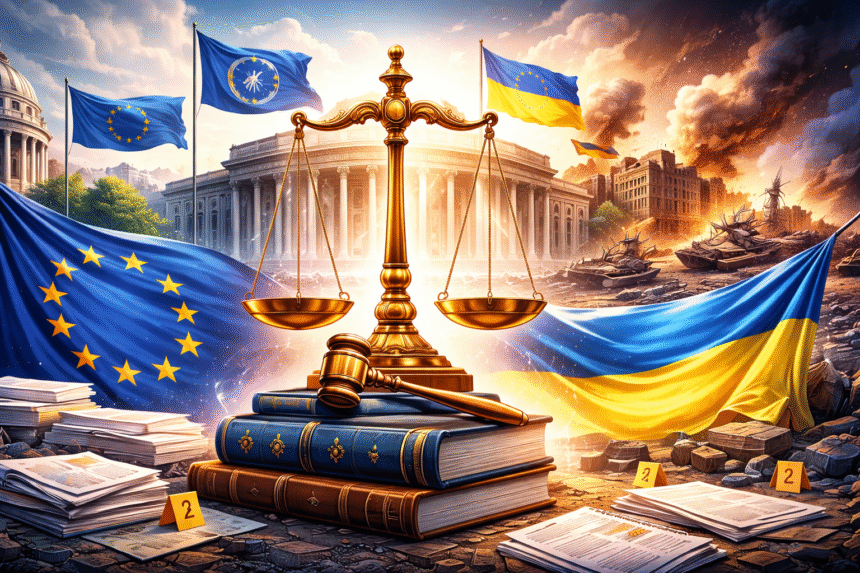
The European Union and the Council of Europe have officially launched a joint preparatory team aimed at establishing a special international court to prosecute crimes of aggression committed against Ukraine. The move marks a significant step toward accountability for the political and military leadership responsible for launching and sustaining the war.
According to officials from both institutions, the preparatory team will focus on the legal, technical, and institutional groundwork required to create the court. This includes defining its jurisdiction, legal basis, structure, and relationship with existing international justice mechanisms, particularly the International Criminal Court (ICC).
The proposed special court would specifically address the crime of aggression — the act of planning, preparing, initiating, or executing an armed attack that violates the sovereignty, territorial integrity, or political independence of another state. While the ICC is actively investigating war crimes, crimes against humanity, and genocide in Ukraine, its ability to prosecute the crime of aggression is legally limited, especially when the accused state is not a party to the Rome Statute.
European leaders have stressed that closing this accountability gap is essential. EU officials described the initiative as a response to the unprecedented scale of the aggression against Ukraine and a reaffirmation of the international rules-based order. They emphasized that impunity for acts of aggression threatens global security far beyond Europe.
The Council of Europe, which brings together 46 member states, is expected to play a central role in providing the legal framework and political legitimacy for the court. Discussions are ongoing regarding the court’s possible location, composition of judges and prosecutors, funding mechanisms, and how suspects would be indicted and tried, even if they are not physically in custody.
Ukraine has strongly welcomed the initiative, viewing it as a critical step toward justice for the decision to invade its territory. Ukrainian officials have repeatedly argued that holding top-level decision-makers accountable is as important as documenting battlefield crimes, as it addresses the root cause of the war itself.
While the timeline for the court’s establishment remains uncertain, the launch of the preparatory team signals clear political intent from European institutions to move from declarations to concrete action. Observers note that if established, the special court would set a powerful precedent, reinforcing the principle that wars of aggression are punishable crimes under international law.
The initiative comes amid continued fighting in Ukraine and ongoing diplomatic efforts to support Kyiv militarily, economically, and politically. For the EU and the Council of Europe, the court is framed not only as a mechanism for justice for Ukraine, but as a long-term investment in international accountability and the prevention of future acts of aggression worldwide.