

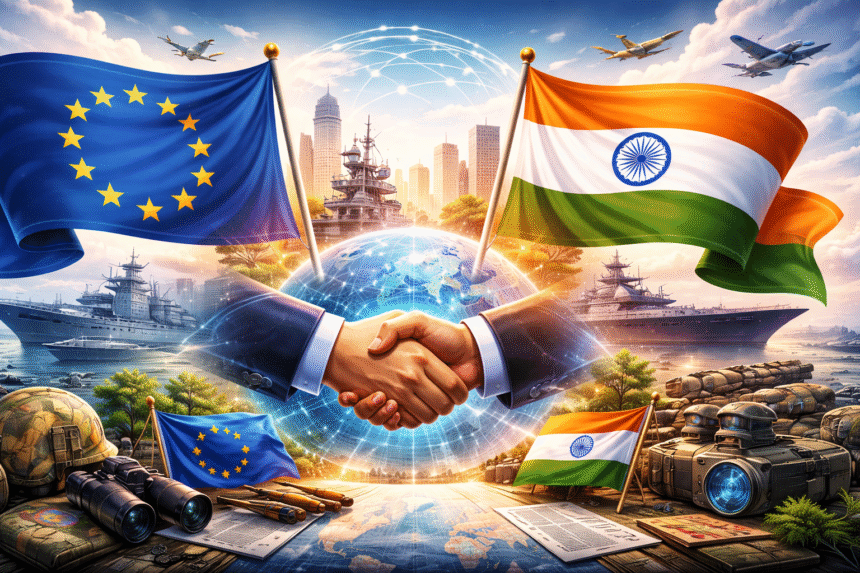
The European Union and India are moving toward deeper defense and security cooperation after signing a draft partnership agreement in Brussels that outlines enhanced collaboration on annual strategic dialogue, maritime security, and counter-terrorism. The development signals a broadening of ties beyond trade and economics into the sensitive realm of defense and regional security.
According to officials familiar with the discussions, the draft partnership establishes a structured framework for regular high-level defense consultations between the EU and India. These annual dialogues are expected to focus on strategic threat assessments, regional security developments, and coordination on emerging challenges such as cyber threats, hybrid warfare, and the protection of critical infrastructure.
Maritime security has emerged as a central pillar of the proposed cooperation. Both sides share growing concerns over the safety of key sea lanes, particularly in the Indian Ocean, the Red Sea, and the wider Indo-Pacific region. European and Indian officials have emphasized the importance of freedom of navigation, combating piracy, and securing global trade routes that are vital to both economies. The partnership opens the door to closer coordination between naval forces, joint exercises, information sharing, and capacity-building initiatives.
Counter-terrorism cooperation is another major component of the draft agreement. The EU and India have committed to strengthening intelligence exchanges, tackling terrorist financing, and enhancing cooperation between law enforcement and judicial authorities. Officials stressed that the partnership aims to address both cross-border terrorism and the growing threat posed by online radicalization and extremist networks.
The discussions in Brussels also reflect a broader strategic convergence. As global power dynamics shift and geopolitical tensions rise, both the EU and India are seeking reliable partners that share an interest in stability, multilateralism, and a rules-based international order. European leaders have increasingly described India as a key security partner, while New Delhi views deeper engagement with Europe as a way to diversify its defense and diplomatic relationships.
While the draft partnership does not constitute a formal defense pact, analysts see it as an important step toward more institutionalized security cooperation. Future talks are expected to explore practical areas such as defense industry collaboration, joint research and development, and coordination in international security forums.
Officials on both sides cautioned that the process will be gradual, but expressed confidence that the framework agreed in Brussels provides a solid foundation for a long-term strategic partnership. As EU–India relations continue to expand, defense cooperation is increasingly seen as a natural extension of their growing political and economic alignment.