

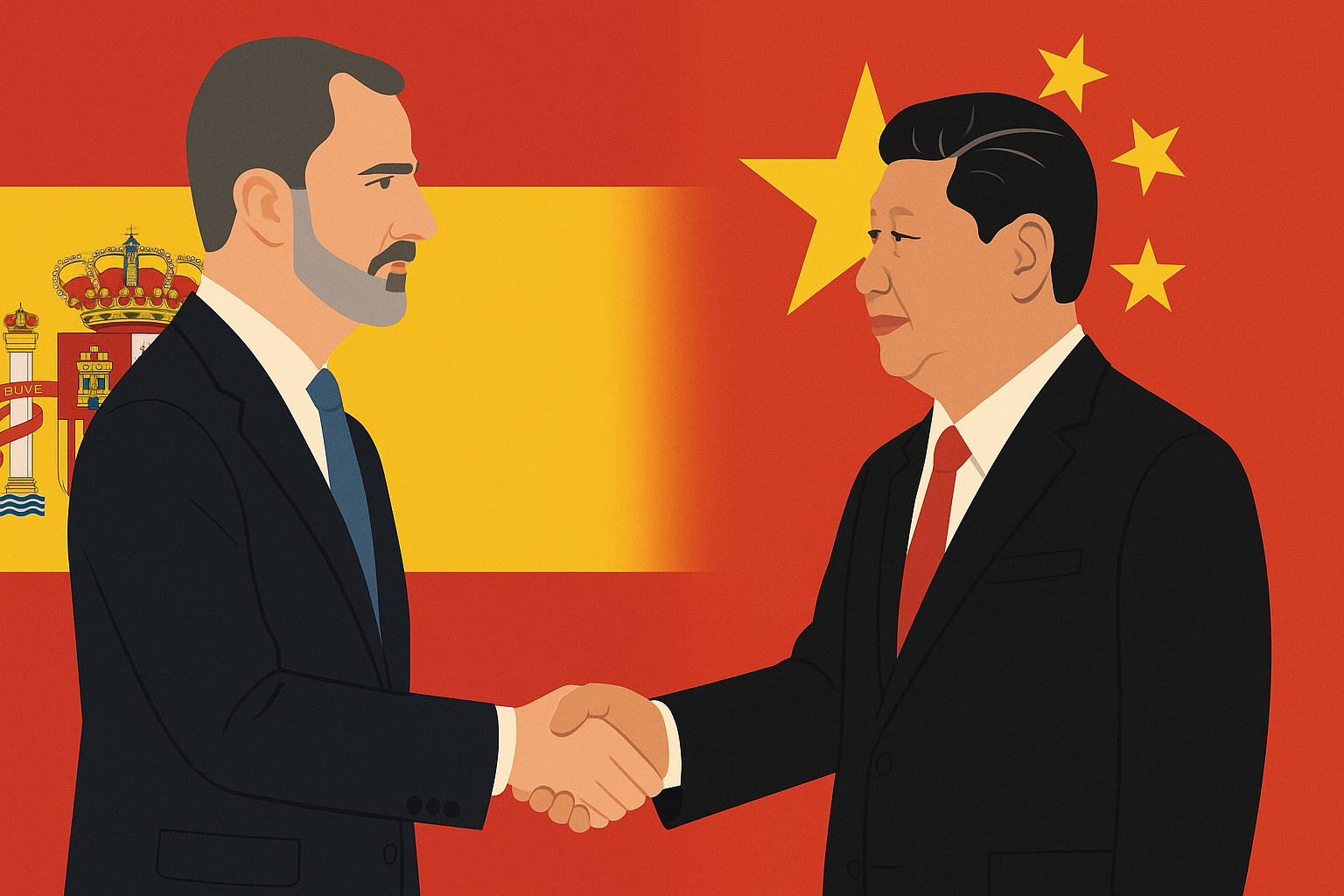
Spain is preparing to send King Felipe VI to China next month in a high-profile diplomatic effort to strengthen economic and political ties with Beijing — making him the first European monarch to visit China in seven years. The visit, coordinated by the government of Prime Minister Pedro Sánchez, underscores Madrid’s ambition to deepen engagement with Asia despite growing U.S. pressure to take a tougher stance on Beijing.
A State Visit Symbolizing “High-Level Relations”
The Spanish royal household is expected to formally announce the state visit in the coming days. According to officials familiar with the plan, the trip will highlight the “very high level” of relations between Spain and China and coincide with the 20th anniversary of the countries’ “Comprehensive Strategic Partnership.”
King Felipe’s visit will be his first trip to China since ascending the throne in 2014, and it follows multiple meetings between Sánchez and Chinese President Xi Jinping in recent years.
Spanish Foreign Minister José Manuel Albares said the mission reflects Spain’s broader foreign policy goals.
“Asia was the region where Spain did not have a historical presence. If you want to have a global foreign policy, you have to talk to everyone — especially China and India,” he told the Financial Times.
Spain’s Balancing Act Between the U.S. and China
The Sánchez administration has cultivated one of the most pro-engagement stances toward China in Western Europe, even as Washington has cautioned against closer alignment. Earlier this year, U.S. Treasury Secretary Scott Bessent warned Madrid that deeper ties with Beijing would be “cutting your own throat.”
However, tensions between Washington and Beijing have recently eased. President Donald Trump and Xi Jinping agreed to delay new export controls on rare earths and semiconductors as part of a one-year trade truce, an agreement that was partly facilitated during U.S.-China talks hosted by Spain in September.
Albares insisted that Spain’s outreach to Beijing does not come at the expense of its alliance with the U.S.
“We have a good dialogue with China. We have an alliance with the U.S.,” he said.
Business at the Heart of the Visit
King Felipe will be accompanied by a large delegation of Spanish corporate leaders, including executives from the automotive, food, energy, and pharmaceutical sectors. Madrid hopes to attract investment from high-tech Chinese firms, particularly in the electric vehicle and battery industries, where China leads in innovation.
A planned €4 billion battery plant by CATL near Zaragoza is seen as a key example of how Chinese investment could support Spain’s industrial future. However, experts and unions have warned that Chinese firms are unlikely to share their core technologies, potentially leaving Spain dependent on foreign innovation.
Spain also seeks to narrow its widening trade deficit with China. From January to August 2025, Spain ran a €26.9 billion deficit, representing 77% of its total trade gap.
A Divided Europe and a Pragmatic Madrid
Spain’s approach contrasts with more hawkish European governments, such as those in Germany, France, and the UK, where China policy has sparked political and security debates. The EU’s growing pushback against Chinese state subsidies and unfair competition has further strained relations across the continent.
In contrast, Madrid has faced little domestic opposition to its China policy. Even after criticism from U.S. lawmakers over Spain’s €12 million deal to use Huawei technology for wiretap data storage, the government has maintained that engagement with Beijing serves Spain’s national interests.
Trump, meanwhile, has criticized Spain for refusing to meet NATO’s 5% defence spending target, hinting at punitive trade measures or even questioning Spain’s alliance membership.
Risks and Strategic Calculations
Spanish officials argue that in a post-unipolar world, Spain must diversify its global partnerships, forging ties not only with China but also with India, Brazil, and the Gulf states.
However, analysts warn that this strategy carries risks. Juan Luis Manfredi, a foreign policy expert at the University of Castilla-La Mancha, cautioned that China views Spain as a gateway to influence European policy.
“China is a neocolonial power trying to increase its bargaining power on European issues through Spain — and it can do that because we need money and finance,” he said.
Manfredi also noted Spain’s limited geopolitical leverage:
“Spain lacks the capacity to coordinate military power, foreign policy, and aid. It’s not well-positioned to stand toe-to-toe with China.”
A Diplomatic Middle Ground
Still, Spain’s stance is viewed by some analysts as pragmatic rather than defiant. Charles Powell, director of the Elcano Royal Institute, argued that Madrid is navigating a divided European consensus.
“Everyone is breaking ranks,” Powell said. “Spain is neither among the most conciliatory nor the most confrontational members when it comes to China.”
As King Felipe VI prepares to represent Spain in Beijing, his visit symbolizes Madrid’s calculated effort to expand global influence, even as it walks a fine line between U.S. loyalty and Chinese opportunity.