


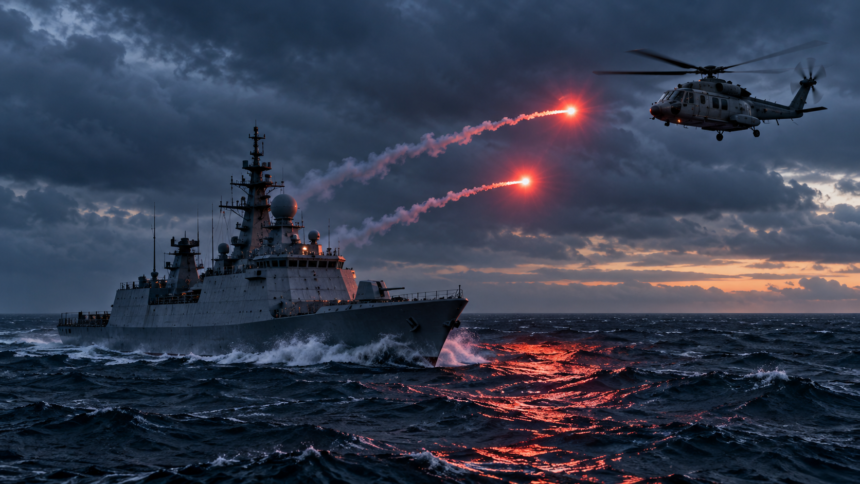
Tensions between Russia and Denmark have escalated following a confrontation involving a Russian frigate and a Danish military helicopter over international waters in the Baltic Sea.
The Danish military accused the Russian warship of firing two signal flares toward its helicopter during an operation off Denmark. Danish officials said the flares narrowly missed the aircraft, describing the action as dangerous and raising concerns about the risk of an unintended military confrontation.
Moscow rejected Denmark’s account of responsibility and accused Danish military helicopters of carrying out dangerous manoeuvres near Russian vessels. Russia’s ambassador to Denmark, Vladimir Barbin, reportedly delivered an official diplomatic note to Copenhagen demanding measures to prevent similar incidents.
According to the Russian side, Danish aircraft approached the frigate in a manner that posed a potential collision risk and could have interfered with equipment aboard the vessel. Moscow also referred to an earlier incident in August 2025, alleging that a Danish helicopter conducted low-altitude flights and hovered above the Russian anti-submarine ship Vice-Admiral Kulakov without establishing radio contact or responding to warnings.
Denmark, a member of NATO, has increased its surveillance of military activity around its territorial waters as security concerns rise across the Baltic region. Encounters involving Russian ships and NATO aircraft have become particularly sensitive because close-range manoeuvres can leave crews with little time to determine whether an action is hostile.
Although signal flares are commonly used for warnings and communication, firing them toward an aircraft can create a serious safety risk. Such an incident could cause pilots to take emergency action or mistakenly interpret the launch as the beginning of an attack.
The confrontation comes amid wider concerns about military activity, drones and suspected interference with critical infrastructure across northern Europe. NATO members bordering the Baltic Sea have strengthened patrols and monitoring operations as the war in Ukraine continues to affect the region’s security environment.
Neither side has indicated that it intends to pursue a broader confrontation. However, the exchange of accusations underlines the danger of miscalculation when Russian and NATO forces operate in close proximity.
The incident is likely to increase calls for clearer communication channels and stricter procedures governing encounters between military ships and aircraft in the Baltic Sea. Without effective de-escalation mechanisms, even a limited confrontation could rapidly develop into a more serious diplomatic or security crisis. Reuters